Showing posts with label Review. Show all posts

Tuesday, January 02, 2007

Maximum City: from a readers desk

Maximum city;I encountered this name from one of Amitav Ghosh’s comment on the book. He was very liberal in praising it, I was curious about Bombay always, many of my close ones live there and they always talk about the city, hence i wanted to read this book by Suketu Mehta and finally read the best book I read last year, and the list includes book like “Hungry tide” too. What this book is about? The title said Bombay lost and found and the end it was for Suketu not for the city, the whole book brings out really breathtaking truths about the city, I would say its Bombay discovered. Salman Rushdies’ in praise for this book said the best description of the ruined metropolis. I was wondering why it is ruined? I was disappointed when I started reading the book, It appeared to me that only criticism is left for the city and after I read the first chapter my fear was confirmed. One may shelve the book if the read only the first chapter. To me Suketus’ home coming after 21 yrs. of stay in Newyork was more of emotion driven that need. Hence he sounded pretty frustrated over the situation in Bombay (he used the city name all through the book). At the end of first chapter I concluded this book is going to be a frustration of an US returned NRI who stayed here for only two and half years. I was so wrong!

“What does a man look like when he is on fire”? Well this was the way the second chapter started and after few lines I realized he is into serious business, I could not leave the book till I finished 584 pages. So what Suketu did? He took the decision to write this amazing book and started working on it with an eye of an anthropologist.

The first chapter he describes his drive towards Bombay, the drive many Mumbaikar can not avoid so easily, he comes back and the new Bombay called Mumbai and that was a revelation for him, he couldn’t identify the place he once belonged to. He was a foreigner in his own city, crisis for roof, water, bad weather, lack of a proper system to run the city and of course the crowd inflow in the city in this book. The high population density and steady inflow of people from outside the state was mentioned many a times in this thesis. He identified the people, who run the city, so he started with the Shiv Sena,

The second chapter is he talks about Hindu extremists. Suketu, though identified himself from hindu religious strata, strongly believed that the hindu extremist group Shiv Sena and their premier Bal Thakrey is pretty much responsible for the present state of the city. This chapter has a shocking description of a man when he was killed in fire and when it was from the killer himself it scares you. It’s a very moving chapter, the life of the people involved in the riot move around places like Jogeswari. The interesting part was his interview with Bal Thakrey himself, it is worth following.

Third long chapter is about cops in Mumbai, Suketu had really put down the vivid inside story goes around Mumbai cops, he gets in touch with a cop who was the key brain behind catching the 1993 Bombay blast accused. The whole chapter goes around the commissioner. His portray of the police department is really excellent, its almost not opinionated. He describes how the encounter specialist were born and the hypocrisies and underworld threat looms over Bombay police: “the second after Scotland yard”.

Without gangstars the city is incomplete hence Suketu gets himself inside the underworld, could bring out the stories about gang war and the lives of the shooters. Probably the most nonchalant way of describing the lives of these murderers, at times you may feel chill passing through you spine! His work never showed any dishonesty to the subject, to know how the big bosses think about themselves Suketu interviewed Chhota Sakeel, one of the most wanted gangster in India now lives in a neighboring country, the leader of the infamous D-Company. As I mentioned you feel chill when he describes about a murder in Bombay which shook the police department thoroughly as they didn’t knew the killers whom Suketu knew!

So his journey to find the lost Bombay doesn’t stop here, he wanted to go deep inside the gutter and discover how Bombay was lost. He met Monalisa a fictitious Bar girl, in a dance bar. It is through her eyes he brought out the painful story about these untouchables it the society. The best part of this section was that Suketu lived inside a story here and became one character, this part of the book I felt most touchy. The life of Honey the man who dances in the bar as a girl will surely leave an impact.

Then comes the Bombay where the new city lives, yes! The bollywood, inside the book, it came out many a time, that the city lives in a movie, starting from Bal Thakrey who according to Suketu gets philosophy from movies, even the ganstars think themselves a character in the movie, so how Suketu did there, well he wrote a script for a ‘hit’ movie called “Mishon Kashmir”! its imaginable how much inside he was in the industry. If you sometimes laugh during going through this book it is this section, its hilarious many times but really tragic. Whether its great Bachhans or Sharukh or Hritwik he came close to every one, he describes Sanjay Dutt’s life inside jail from his own version which media also did not have access to. He became a close friend of the renowned director Vidhu Vinod Chopra and Mahesh Bhatt. It was really interesting to know how people struggle inside the industry how the D-company clouds looms over them, and the extortionists and the sensor board the extremely sensitive crowd, it is an amazing description.

Does the story end here? No, so Suketu scripts a middle class family with aspirations inside, they move out from the slums to a small flat outskirt of Mumbai, as usual middle class stories don’t have excitements but you will feel the difference about Bombaities for sure. Their ambitions and needs are different from the others. How about the foothpath? Stats says 50% of the foot path in Mumbai is occupied by people, Suketu finds a poet in the street! The problems with Biharis in the city comes alive here. The young Bihari poet has been a representative of the dreamers inside the city.

The last chapter is the most violent without any decscription of bloodshed; he was talking about a Jain family who are becoming a monk. It is really beyond my imagination that how it will feel when the whole family stay together but without interacting and follow some rituals.

This book is a great example of the best kind of journalism. I would have tempted to say crime journalism, but he went beyond that. The lucid language of Suketu will really impress you. Many places his statement will surely leave more impact that the whole description. His writing was not opinionated at all. He praised the city dwellers at times, Mumbai is a safe city, much safer than the other cities in India, no mugging, people help out if you are in trouble. Girls can freely roam around 12 in the night, which is not imaginable in cities like Delhi. Maximum city really deserves credit, though there are criticisms about this book, but i should say hats off to Suketu!

Saturday, September 09, 2006

This novel..

I read this 'goddamn' novel called "The catcher in the rye" by J. D Salinger. I liked it 'and all' but many a times Holden 'killed me'. I liked many parts of it but this speech by Mr. Antolini was really good.

"....This fall I think you’re riding- it’s a special kind of fall, a horrible kind. The man falling isn’t permitted to feel or hear himself hit bottom. He just keep falling and falling. The whole arrangement’s designed for men who, at some time or other in their lives , were looking for something their own environment couldn’t supply them with . Or they thought their environment couldn’t supply them with. So they gave up looking. They gave it up before they ever really even got started...."

Friday, September 01, 2006

Life around "soft techies"

Bangalore, the IT hub, accommodates a large portion of the people working in the software industries. Last few years there has been a lot of noise about it around the world. Usually social studies on this kind of places must be interesting and that is precisely what anthropologist Carol Upadhaya is doing in NIAS. Today CCS, IISc screened couple of documentary films at physics lecture theatre. They were directed by Gautam Sonti with collaboration with Carol. The first movie they screened name “Fun @ Sun” and second one was “July boys”. There is no doubt that the director had hard time in getting into the training session of Suns Microsystems or the conference room of July systems but they could bring out the message they wanted to. In Sun they focused on the training the newcomers undergo as well as the socializing, like the Friday bash! As Carol mentioned at the beginning that communication skills in this MNC world means adapting oneself to a different culture. Socializing or approaching a problem in these global companies are very different than it is taught to the young engineers, hence a moulding is essential. That’s what came out from the film fun @ sun. There was an interview with the VP, Vijay Anand, and that too brought out the fact that a change in the culture of doing things is something they concentrate upon. July boys is quite different, it had mainly aimed at the corporate life of a company which is Indian but very global in nature. Surely the company sustained in the market because of their adaptability to the culture. This start up venture July systems in Bangalore, makes games, and other mobile ph. based software for Europe and USA. Its very important for them to find the right pulse and that needs a better communication rather better understanding of the culture. Couple of things were very similar in these to companies, the free space in quite huge in them, your attire or your way of communicating doesn’t become obstacle also the freedom to ask any one almost anything is very important and I felt these are probably very few nice points touched upon. Overall I would say it was a new experience presented by Gautam and Carol to us, hope Carols research will bring us few more such unknown realities about IT industries.

Monday, July 24, 2006

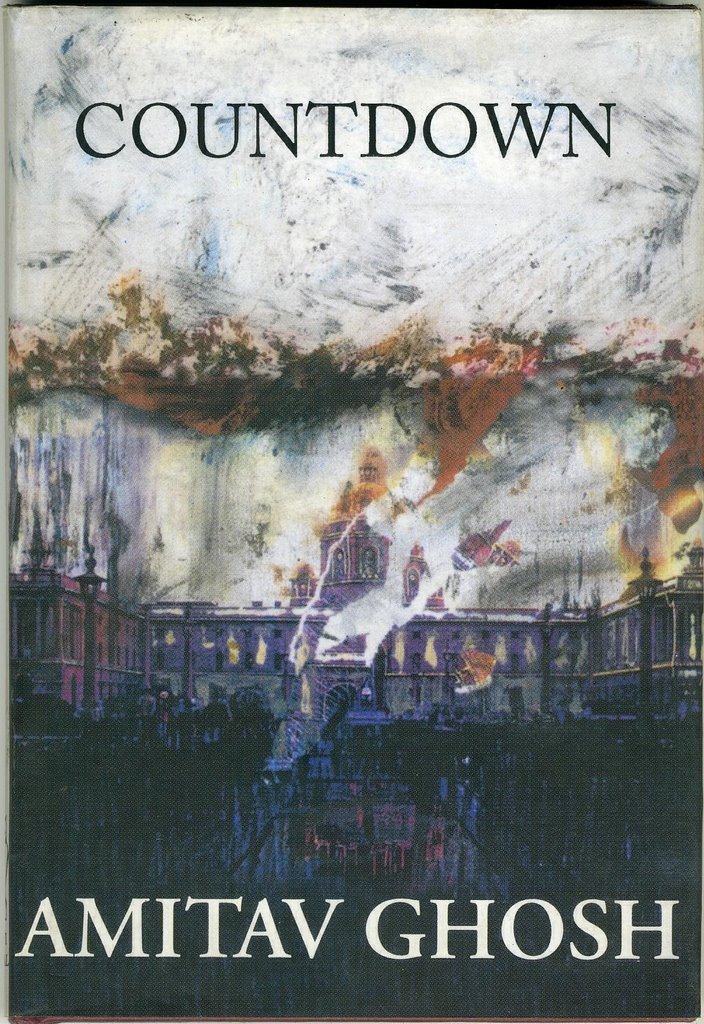
An anniversary and " The countdown"

I started this blogging journey just a year back. It was really a different experiment. though it was not the first time I was writing something, it’s a childhood habbit. One striking similarity between that writing and this writing is that both were an open source essays! Yes my childhood diary which i still carry with me was corrected by one of my teacher! Although he had only academic interests but still is was accessible by any one around me. This one is no way different; I tried to write different things in different moods. The 40 posts I have are different, so lets start repeating it. My first post was a few lines on one of my favourite book "we the living" and today i want to write few lines about a book from my another favourite author Amitav Ghosh.

...........This is one of Amitav Ghosh's books which I think was not' read by many readers, like they read "Shadow lines", "Dancing in Cambodia...” or "Hungry tide...” The book I am talking about here is "Countdown". Amitav Ghosh wrote about many countries and civilizations and I found the anthropologists view is evident everywhere. I was curious how he would have described the relationship between India and Pakistan where emotions flow like river both for hatred and friendship, but there is surely a neutral view and Ghosh represents this in an outstanding fashion. This article is written just after India and Pakistan have carried out their respective nuclear tests. This book was an outcome of Authors travel in both the countries after the explosion. He interviewed many people both in India as well as in Pakistan. He begins the essay by describing the political scenario in India as well as in Pakistan. In India BJP was in power and this was for the first time when a not so secular govt. was in power, whereas in Pakistan, Nawaj sharif was planning to get away with the conventional law and implementing religious laws, in this changing environment these test carried lot of significance in the subcontinent. Although Ghosh never hid his views against the nuclear tests still he never showed any bias towards his views. There were couple of interviews around which the article grew, were excellent. One is with Mr. George Fernandez, then defense minister of India and Asma Zahangir the noted human right activist from Pakistan. The political and social background of these two persons actually was very helpful in understanding the views they expresses Amitav Ghosh is really good at that. Both of these celebrities expressed a common concern about the deterioration of the values and death of the ideas followed by these two countries. It came to me with a little surprise that the view towards nuclear weapon is very different in India and Pakistan. In India people see nuclear weapon as a symbol of strength which will never be used whereas in Pakistan there is a real anticipation of a nuclear war. This is how Ghosh had envisaged attitude towards nuclear weapon, but when I read the news today that Pakistan is piling up 20 times more nuclear war heads per yr., its sounded like Amitav Ghosh was quite right in understanding the pulse of both the views. The last part of the book is something I never thought author will address: the devastation that will follow a nuclear attack on Mumbai or Delhi, a chill passes through your spine when you imagine the devastation foreseen by the scholars . It has been beautifully explained with all scientific support. This book is as good as the other creation by Amitav Gosh. Salute to him.

Tuesday, December 13, 2005

spread your wings and fly eagle.. Desmond Tutu

The notice on a pink colour A4 paper remained un-noticed in the campus, and it gave some of us an opportunity to listen to Desmond Tutu the Nobel Peace prize winner for the year 1984. I miss most of the Nobel laureate lecture in the Institute because I reach late and the halls will be completely filled, this time it was in J. N. Tata auditorium and because of mentioned reason I could hear this piece of lecture. The presence of sniffer dog/bitches from the police near the stage gave really a wrong introduction to right event.
The speaker of the 7th and the last J.R.D Tata memorial lecture, organized by NIAS was Arch Bishop Desmond Tutu from South Africa. He was really humble at the beginning of the talk. He spent almost 10 min. in thanking us, the Indians. I rarely hear someone talking about Mahatma Gandhi with such emotions. If I am hurting someone, then let me confess I heard very few of them. He sounded more like a Global Spokesman of peace than an arch bishop from Capetown, who fought apartheid and the man behind the reconciliation mission. Of course, South Africa has moved ahead from the apartheid era, but still I wonder how this reconciliation is done; atrocity must be at a level where punishment is the solution. His talk was a reminder of the last century’s blood bath all over the world, and the born of so called super powers who carried that legacy to the next century in the name of west vs. Islamic terrorism. He criticized the America and Britain for their unwanted and unnecessary invasion in Iraq where thousands of people were still getting killed. If the description of the talk is becoming serious then let me put down that he also had a humorous touch in his talk and he mixed them really well. He described the incidents, one about the women who came to the reconciliation court and was requested for forgiveness, and the other of the hotel manager in Washington who mistook him as a chauffer, with equal intensity! There were parts of the lecture where he talked about the oppression, quite depressing but when I read his Nobel lecture, I found he actually didn’t talk about oppression much. Surely, he followed his talk titled “is there hope for humanity?”. Arch Bishop Tutu, is in a UN committee called alliance of civilization and he is carrying out the job for getting together the civilizations around the world, according to him, we can prosper only when we are together. Human being lives in the world of Gandhi, Mother Teresa, and Martin Luthar King (junior), and they are like eagles that fly towards the rising sun and disappears. It was a quite unusual lecture for us but hats off to the man from Capetown!

Few links!

His Nobel lecture

His peace centre

Sunday, July 24, 2005

We the living

I read this novel by Ayn Rand recently, i thought the title of the book will be nice title to start with and i wrote something on the book..........

This novel by Ayn Rand like her previous novels conveys a unique philosophy towards life and her way of describing it is also unique. The novel gets its life in Leningrad (or Pterograd) in Russia and it flows into different corners of Leningrad. The story is around a girl called Kira Argounova, a very strong character with a vision in life. She spends the cream period of her life in a time of political and social turmoil in Russia during the year 1917-1930. After the Bolshevik revolution and demolition of imperialism, it was the time of reconstruction. It was the time when Kira arrives in Leningrad with a new social tag; she was a “burgoa”. With the proletariat government in power, Russia was under going a social change a fresh idealism which carried out by a true proletariat Andrei Taganov. and by Leo Kovalensky(s) a young man rebelling against the totalitarian system. Kira, a character with values, could see the death of values and lack of vision in the new born society; she eventually falls in love with Leo. Kira’s father who was a industrialist now found it difficult to get bread for living. Kira and Leo both were rebellion in their own way, Kira wanted to be in the system and then revolt when she had enough strength; on the other hand Leo was mocking the system by destrying himself. The best part of the novel is the interaction between Andrei Taganov and Kira. Two completely different ideologies meet each other with some common principles and then move on parallel. The consequences of this relation are far fetched. The characters evolved with time with changing social backdrops. Corruption was taking over the regime which was based on idealism. Proletarian were replaced by corrupt escapists. The pace of the novel is fantastic, though the change in the communist reign in Russia took a long time but this book actually describes why the change was necessary. Kira who aspired to become an engineer and built a bridge made of Aluminum continued her struggle but fails. Andrei who dreamt of a society where everyone will have equal rights to live finds himself giving berth to one which lacked everything he had once thought of. Leo who wanted to live life in his own way destroys all the values he lived for. The novel is about a philosophy and it leaves a strong impression about life on you.