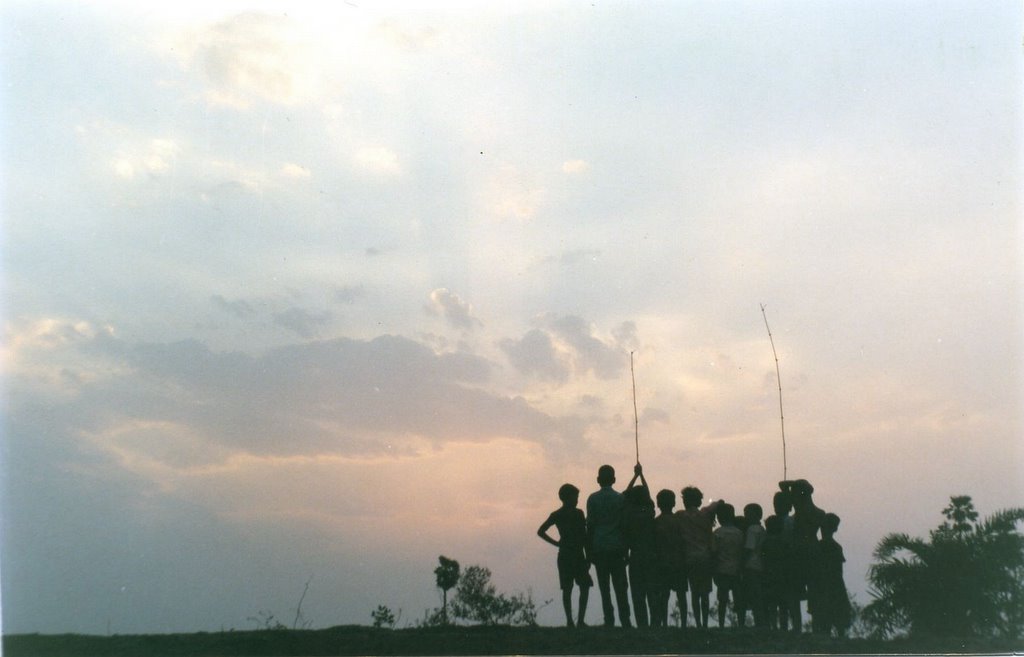
 This photo, was hiding in some corner in my PC. When i took it, didn't have much impact but now i could see the life inside the light :-)
Sunday, February 26, 2006
light of life
This photo, was hiding in some corner in my PC. When i took it, didn't have much impact but now i could see the life inside the light :-)
Friday, February 03, 2006
Pass it through nanotube, it'll be quick
When I started working on ceramic membrane I was fascinated by the science. Especially working with the unsupported alumina membrane where you control the pore size at the nanometer level. Its quite tricky playing with these membranes. The problem is associated with filtering. It can filter out very small molecules easily but as the channels becomes smaller the wall friction affects the flow (Hagen-Poisullie equation), thus quite high pressure is required to pass the fluid through filter. Duration of the filtering process due to low fluid velocity also becomes extremely long; certainly from application point of view this is disadvantageous. There is a brighter side of the story! Recently my undergrad seniour, Mainak has published a paper in Nature couple of months back on carbon nanotube membranes, this paper addressed very similar problems. This group from University of Kentucky has made multi walled carbon nanotubes with graphite as the inner core; the average channel diameter is around 7 nm. When water is filtered through these membranes, the fluid velocity was observed to be few orders of magnitude higher compared to the theoretical prediction. The experiment was carried out on few other fluids and the results were very similar, they also observed that the flow rate does not decrease with velocity of the fluid, that’s really an interesting observation. The reason cited for this enhanced flow is the hydrophobic nature of graphite which makes the wall almost friction less to flow. There is also a possibility of forming ordered hydrogen bonds inside the tube. This behaviour is analogous to the biological cells where water passes through the protein wall at considerable pace. Following this claim carbon nanotube will have a huge application coming in, mostly as sensors and filters against corrosive gases. The important part of the question which I felt quite interesting is: if the conventional concept fluid flow in a tube breaks in case of MWCNT, will it hold for other systems? Does nano has any effect here? I f you remember I wrote something about nanomechanics by John Pethica, where he mentioned an increase in viscosity of water molecule when put between very thinly spaced walls. Although these distances are smaller compared to nanochannels, the flow rate must get affected when the pore size is reduced more. That technology is yet to come; we will probably witness subnano effects influencing flow.
Thursday, January 19, 2006
Its not a "Bat", its Materials Engineering
They say cricket is ruled by batsmen. Unfortunately people get more entertainment for watching boundaries and overboundaries not by waiting for a wicket to fall. All these fun comes from couple of pieces rather few pieces of wood, called bat. International Cicket Council has a poor definition of this piece. A bat looks like this
can not be longer than 96.5 cm including the handle and maximum width shouldn’t exceed 10.8 cm. must be made of wood. There is no restrictions on the weight of the bat (typically 3 lb), the shape: well its understood, there is no definition by ICC. The blade of the bat can be covered with some material for protection and repair, should not strengthen the bat and the thickness of this cover should not exceed 1.56 mm. Recently a committee headed by Sunil Gavaskar, recommended some more criteria, the important one for this case is that you can not infiltrate anything in the blade moreover it should be made of one solid piece of wood.
Where is the scope for improvement? Material scientists and engineers step in here, before addressing this issue let us know where we need improvement. Of course ball should travel faster than what they do now. When a ball hits the bat at a very high speed, there are lots of vibrations and minimizing this has been challenge for sometimes. Striking the ball hard is easy when its hits at the “sweet spot”. This region is almost 12 cm above the bottom of the bat, the thickest part, we define this place as the place where minimum vibration is felt and the ball travels much faster. The sound we say heavenly when it hit this sweet spot. So extending the sweet spot region is also an important issue.
How to go about it? There are few research institute and Universities in Australia and in England are really doing quite a bit of research in these field. The departments associated with this are Material Science and Design, so its science and engineering combination. Lets see a bat, it has go 2 parts, one is solid part the one piece wood one and the other is the handle. The handle is a composite material its made up of canes put together with rubber and adhesive in between. This actually dampens the vibration which comes after the ball hits the bat. In RMIT university in Australia researchers are trying to make the handle with a composite material containing carbon fiber and polymer, this dampens the vibration more compared to conventional handle. This is the bat which probably Rickey Ponting wanted to use last year, under ICC supervision. In case of base ball bat the vibration control system is a piezoelectric device, which generates voltage to nullify the effect of vibration, it’s a software controlled process and these software were developed after a rigorous study on vibration, soon in cricket too we will see such modification setting in. Due to the rules we can not progress much with the blade part from the material science point of view, this is a pure problem for designers, design aspect only can extend the sweet spot. Tennis and Golf has progressed a lot in these regards. They are using the best possible materials for such application, reinforced graphite of bulk metallic glass are few should be named. Lets hope ICC will overcome its conservative resistance and make cricket more exciting.
Some links:
ICC home page
Bat size specification

can not be longer than 96.5 cm including the handle and maximum width shouldn’t exceed 10.8 cm. must be made of wood. There is no restrictions on the weight of the bat (typically 3 lb), the shape: well its understood, there is no definition by ICC. The blade of the bat can be covered with some material for protection and repair, should not strengthen the bat and the thickness of this cover should not exceed 1.56 mm. Recently a committee headed by Sunil Gavaskar, recommended some more criteria, the important one for this case is that you can not infiltrate anything in the blade moreover it should be made of one solid piece of wood.
Where is the scope for improvement? Material scientists and engineers step in here, before addressing this issue let us know where we need improvement. Of course ball should travel faster than what they do now. When a ball hits the bat at a very high speed, there are lots of vibrations and minimizing this has been challenge for sometimes. Striking the ball hard is easy when its hits at the “sweet spot”. This region is almost 12 cm above the bottom of the bat, the thickest part, we define this place as the place where minimum vibration is felt and the ball travels much faster. The sound we say heavenly when it hit this sweet spot. So extending the sweet spot region is also an important issue.
How to go about it? There are few research institute and Universities in Australia and in England are really doing quite a bit of research in these field. The departments associated with this are Material Science and Design, so its science and engineering combination. Lets see a bat, it has go 2 parts, one is solid part the one piece wood one and the other is the handle. The handle is a composite material its made up of canes put together with rubber and adhesive in between. This actually dampens the vibration which comes after the ball hits the bat. In RMIT university in Australia researchers are trying to make the handle with a composite material containing carbon fiber and polymer, this dampens the vibration more compared to conventional handle. This is the bat which probably Rickey Ponting wanted to use last year, under ICC supervision. In case of base ball bat the vibration control system is a piezoelectric device, which generates voltage to nullify the effect of vibration, it’s a software controlled process and these software were developed after a rigorous study on vibration, soon in cricket too we will see such modification setting in. Due to the rules we can not progress much with the blade part from the material science point of view, this is a pure problem for designers, design aspect only can extend the sweet spot. Tennis and Golf has progressed a lot in these regards. They are using the best possible materials for such application, reinforced graphite of bulk metallic glass are few should be named. Lets hope ICC will overcome its conservative resistance and make cricket more exciting.
Some links:
ICC home page
Bat size specification
Sunday, January 15, 2006
This one is really tiny
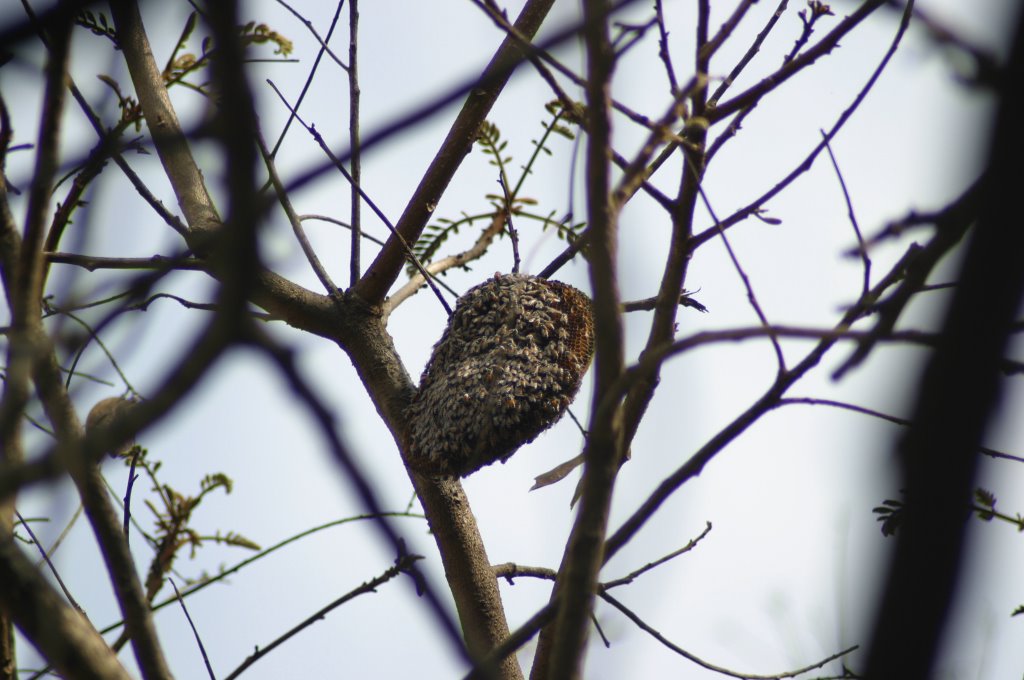
Phani noticed this hive yesterday; intially we did not know whether that is a bee hive or not, we thought it may be a flower but later i could see a bee flying. now it is almost clear that it is a bee hive. In our campus we are habituated in seeing the big hives with a diameter sometimes more than 2 feet. and the bee sizes are of few cm. For example the bee hives that is forming in my balcony for last two years in Feb, will be huge enough to scare any giant! first time i didnot open my balcony for 15 days, but when mr. ponnana came from CES to remove them, i got the courage and next year i did not feel troubled at all, it was my neighbours turn to get scared :), but this one is really tiny. Life cycle of bees has been roughed throughly in the literature, even text books in school contain detail about them. There are faculties in the Institute who are working on them, i hope to get some info about these bees and write and update.
Sunday, January 08, 2006
"Stardust" is coming back
Just couple of years back the image came in front page of thousands of magazines and news papers around the world. An aircraft colliding with a comet! Analogies were drawn with the movies like “deep impact” and “Armageddon” and details of the impact was getting significant attention of media when compared to politics and sports. The process was really accurate; the way it has been executed was amazing.
The reason I am discussing all these is: on Jan. 15, 2006. Stardust is coming back to earth after seven years of its launch and two years after it had hit the comet, gathered information and dust particles. This was one of NASA’s first endeavour towards the research on origin of life. The 25 kg spacecraft has already shifted its penultimate step towards journey to the earth and NASA says it was perfect. This comet is suppose to carry dust particles which is as old as life on earth and may contain some real evidence for it, but that is future, now the scientist are holding their nerves so that every thing goes smooth. There are reasons for concern, stardust is going to be the fastest return aircraft from space and it will hit the earth with a speed similar to a bullet. Although scientist have predicted that it will be visible from some places in USA in naked eye, but real challenge is tracking the spacecraft, and its place for impact. Wish everything goes well
My interest is in the materials part. Normally these spacecrafts have a shielding of carbon based refractory material, which can withstand temperature more than 5000 K, but here it will be tested. Due to very high friction the material will evaporate and the chemistry of the surface will change. It will be also interesting to see how it reacts to the impact. Heat shielding will really be a very important material for research. Stardust is coming back as an experimental result, which can not be carried out anywhere near earth.
Best of luck guys!
The reason I am discussing all these is: on Jan. 15, 2006. Stardust is coming back to earth after seven years of its launch and two years after it had hit the comet, gathered information and dust particles. This was one of NASA’s first endeavour towards the research on origin of life. The 25 kg spacecraft has already shifted its penultimate step towards journey to the earth and NASA says it was perfect. This comet is suppose to carry dust particles which is as old as life on earth and may contain some real evidence for it, but that is future, now the scientist are holding their nerves so that every thing goes smooth. There are reasons for concern, stardust is going to be the fastest return aircraft from space and it will hit the earth with a speed similar to a bullet. Although scientist have predicted that it will be visible from some places in USA in naked eye, but real challenge is tracking the spacecraft, and its place for impact. Wish everything goes well
My interest is in the materials part. Normally these spacecrafts have a shielding of carbon based refractory material, which can withstand temperature more than 5000 K, but here it will be tested. Due to very high friction the material will evaporate and the chemistry of the surface will change. It will be also interesting to see how it reacts to the impact. Heat shielding will really be a very important material for research. Stardust is coming back as an experimental result, which can not be carried out anywhere near earth.
Best of luck guys!
“Startdsust”
Saturday, January 07, 2006
A place named Purulya
I grew up in Purulia. One of the most peaceful places I have ever seen. Irony is that whenever I mentioned to someone that I hail from Purulia, they immediately recognize the place, “oh! Where the arms dropping took place?” I am sure soon people will identify the place again, for wrong reaons: “Oh! Where there is lot of unrest because of Naxalites?” No. This is not Purulia, and the people who did or doing all these are also not from Purulia. I was born in a place where, nobody was aware of peace because they had never seen violence, but it was quite an isolated district in Bengal more because its late inclusion in the state. Although the district was lagging behind in terms of economy, education, food crop production, yet culturally is much ahead of the other districts in the state, and fortunately, partition couldn’t touch it. “Chhau” the dance is considered as one of the cultural symbol of not only of west Bengal but also in some cases India, but then like “kathakali” we did not have money to protect it, and it is difficult to practice culture when you earn a meager meal once a day! then there was “Tusu and Bhadu”. “Sankrnati” is celebrated as the harvesting festival in major part of India, Purulia is also not an exception, but there is “Tusu and Bhadu”. Crop harvest is very small in the district and that’s being one of the major causes for economic fall in this part. “Bhadu” is a festival of woman and they make nice structures like temples with colourfull papers. You will see a procession of woman singing songs, they are not written anywhere! People memorize it. I heard recently that there is an effort to have them in written form. So this is Purulia. In our childhood we knew more about “Pataliputra” than Calcutta.
Purulia is extremely politically impassive and religiously indifferent district. It has more than one third of villages staying below poverty line. Industries were opened and shutdown came sooner than expected, thanks to the unions which were very active in these cases. A perfect situation for exploited by the Maoist groups. The recent killings in Bundwan can not really justify any cause. Its good if someone comes ahead and fight for the people’s right, but violence can take it anywhere. I remember a place called Duarsini, near Bundwan we went for picnic when I was in school, now that place even armed men wont venture to go. Its valid for Kuilapal another beautiful landscape was developing as a tourist spot no longer a destination for tourists. A little more attention would have changed lot of things, still I believe people don’t like violence but at the same time their affinity towards government probably is not mention worthy.
Purulia is extremely politically impassive and religiously indifferent district. It has more than one third of villages staying below poverty line. Industries were opened and shutdown came sooner than expected, thanks to the unions which were very active in these cases. A perfect situation for exploited by the Maoist groups. The recent killings in Bundwan can not really justify any cause. Its good if someone comes ahead and fight for the people’s right, but violence can take it anywhere. I remember a place called Duarsini, near Bundwan we went for picnic when I was in school, now that place even armed men wont venture to go. Its valid for Kuilapal another beautiful landscape was developing as a tourist spot no longer a destination for tourists. A little more attention would have changed lot of things, still I believe people don’t like violence but at the same time their affinity towards government probably is not mention worthy.
Changes that took place certainly were late; development is taking place from the middle of nineties. Town wise Purulia has advanced quite a bit, you can get mobile phones servies from atleast four to five service providers. The huge pump storage power project in collaboration with Japan in Ayodhya hills has really changed the roads, economy of this region. Even 15 years back it was a nightmare to go to the hills in rainy season, it has improved now. Government although not new is trying to boost up the economy. Its almost 8 years since I last visited Purulia, wish when I go there next time it will be the same cool and hot "Purulya".
Friday, December 30, 2005
Candle lit vigil
Today the students in the campus have decided to have a candle lit vigil in front of the main building. It is a geture we carry out to pay homage to the souls who are no longer around us and for spreading the message of peace. It was a very peaceful gathering of 150 students. The director, prof. Balram was as usual very inspiring but appeared really weary, of course because of the unusual circumstances he faced. We condoled the sudden demise of Prof. Puri, and hoped for a faster recovery of those who are recovering in the hospital. After the vigil we had put the candles at the steps wher J. N. Tata is standing tall. The glowing light carried a promise to walk ahead and and remeber the Prof. Puri. At the end the gathering was asked to speak a few words but the silence was talking; We all despised this heinous act.
Thursday, December 29, 2005
Attack inside IISc !!!?
This is the same J. N. Tata Auditorium where the peace ambassador Desmond Tutu talked about peace in this part of the world. This is the place where we saw “Keepers of the flame”, the life documentary on Tatas and we were shown future path of our country, and yesterday we encountered the path which we are traveling through. Few cowards with automatic Kalashnikov has fired indiscriminately on delegates of an international conference in front of J. N. Tata auditorium. When I heard the shooting sound from the lab it was like firecrackers which lasted for 30 sec. In my worst nightmare i haven’t seen such act. Though jolted by the news, frantic calls and ambulances really perturbed the campus, life became normal in the night It was really shocking, we all mourned at the demise of prof. M. C. Puri, and we wish a fast recovery of the others injured in the shootout. Prof. Vijay chandru is a quite known figure in the campus and we hope he’ll be back on his feet very soon.
Inside the campus we always get bugged when a byke’s accelerator crosses some limit, no doubt this incident perturbed the campus but within one and half hours only TV channels were busy discussing it, most of the student had gone back to work. It’s a busy life in the campus; the spirit always carries through day and night in silence. It a shame on the guys who attacked un-armed delegates and researchers. I don’t know their purpose, whatever it is we believe there is no novel cause which can justify such acts. If they have strong will they should come forward and fight not with arms, it is cowardly and if they had thought they will hit a weak zone, certainly they have chosen the wrong place. They should come to the campus and see that nothing has changed except some physical marks they left here yesterday evening. I don’t know whether this/these guy(s) will be caught or not, but it is sure, in India we have learnt to live with it. So if someone wants to create an impact, they better find some new tricks!
Inside the campus we always get bugged when a byke’s accelerator crosses some limit, no doubt this incident perturbed the campus but within one and half hours only TV channels were busy discussing it, most of the student had gone back to work. It’s a busy life in the campus; the spirit always carries through day and night in silence. It a shame on the guys who attacked un-armed delegates and researchers. I don’t know their purpose, whatever it is we believe there is no novel cause which can justify such acts. If they have strong will they should come forward and fight not with arms, it is cowardly and if they had thought they will hit a weak zone, certainly they have chosen the wrong place. They should come to the campus and see that nothing has changed except some physical marks they left here yesterday evening. I don’t know whether this/these guy(s) will be caught or not, but it is sure, in India we have learnt to live with it. So if someone wants to create an impact, they better find some new tricks!
Saturday, December 24, 2005
The big controversy in cricket
Probably the biggest controversy in the recent times in cricket has hit the media. Nup! not Saurav or Greig, its with the greatest spinner Murlitharan and Shane Warne. After the controversial stament by Shane where he indiacted to a famous bowler (presumably Murli) in the world cricket captured lot of wicktes playing against minnows like bangladesh an Zimbabwe. Well Arjuna Ranatunga the fighter fought back saying that Shane's most of the wicketes came from the teams like South Africa and England and Westindies, who doesn't play spin well, not against India the masters against spin (thank god they didn;t forget it). Most of his wickets came as tail enderes and he is an overrated bowler. i am sure there going to be huge discussions about it statistics has been already popping up, but seeing the statistics i was wondering both the partys should keep quite if their performence is kept agains Kapils performence, who never played against Zimbabwe or bangladesh, and he was a Fast bowler from India! if we take out 150 wickets from both of these bowlers, Statistics from Kapils career would look certainly brighter. May be they should stop at this because both of these spinners are really greats and their bowling it is always a treat to watch, perhaps its a time they along with their friends keep quite because we can put Kapil ahead of them :D
Friday, December 23, 2005
nanomechanics and Prof. John Pethica
Mechanics although sounds mechanical but its starts from the chemistry of atoms and you have mechanics when two atoms comes close to each other. This is how Prof. John Pethica looked at mechanics. Prof. Pethica is a big name in the field of contact mechanics and became quite popular in the campus. His cv is all over the web and I don’t want to write it here.
When two bodies come close to each other there are attractions and repulsion which act on them, and probably this is the first time I saw somebody really, experimentally showing the typical energy plot that we find in all basic material science book Prof Pethica and his group has done it using AFM. He explained the mechanism which drives an atomic force microscope to read the atoms. The striking technology is in the resolution. A laser goes through the tip and reflects back and by detecting the multiple reflections that is coming back, through which it was possible to achieve atomic level resolution in AFM. The probe for AFM can be used as a tool for striking the antom and calculating bond strength between the atoms. So you can literally feel the chemistry of the atoms. It’s really fascinating. So Prof. Pethica’s group in Dublin is working with some technique, developed most probably by them, which is called modulated amplitude AFM technique, this is very effective in measuring the single tip surface bond, the mechanism is bit complicated but it has responses coming in femto seconds and there are advantages over the other tips used for this purpose. After mesmerizing the audience with his measurements in the atomic scale he shifted to some interesting studies on molecules. No, it’s not the big organic molecule, it is water molecule. When the water molecules are kept in between two plates with sufficiently closer (less than nanometer) you start seeing some changes such as viscosity and those change are because of the contacts between the water molecule and the surface. It’s an interesting study from the point of view of biologist as inside a cell the length scale in which water molecules sits is almost similar in order. Prof. Pethica, at the end of his lecture showed few slides of the nano science building at the heart of the town in Dublin. He really wanted to convey the importance of the nano science and technology, but I had a feeling that he has reached beyond that!
When two bodies come close to each other there are attractions and repulsion which act on them, and probably this is the first time I saw somebody really, experimentally showing the typical energy plot that we find in all basic material science book Prof Pethica and his group has done it using AFM. He explained the mechanism which drives an atomic force microscope to read the atoms. The striking technology is in the resolution. A laser goes through the tip and reflects back and by detecting the multiple reflections that is coming back, through which it was possible to achieve atomic level resolution in AFM. The probe for AFM can be used as a tool for striking the antom and calculating bond strength between the atoms. So you can literally feel the chemistry of the atoms. It’s really fascinating. So Prof. Pethica’s group in Dublin is working with some technique, developed most probably by them, which is called modulated amplitude AFM technique, this is very effective in measuring the single tip surface bond, the mechanism is bit complicated but it has responses coming in femto seconds and there are advantages over the other tips used for this purpose. After mesmerizing the audience with his measurements in the atomic scale he shifted to some interesting studies on molecules. No, it’s not the big organic molecule, it is water molecule. When the water molecules are kept in between two plates with sufficiently closer (less than nanometer) you start seeing some changes such as viscosity and those change are because of the contacts between the water molecule and the surface. It’s an interesting study from the point of view of biologist as inside a cell the length scale in which water molecules sits is almost similar in order. Prof. Pethica, at the end of his lecture showed few slides of the nano science building at the heart of the town in Dublin. He really wanted to convey the importance of the nano science and technology, but I had a feeling that he has reached beyond that!
Saturday, December 17, 2005
Space Research
Discovery of vacuum was a revolution, its helping someway or other the poor souls like ours, but life moves on. Once we have vacuum we can do lots of model experiments, that will gives us a clue of what can happen in the space above us, but, hold on, you can not get rid of the gravity so easily until you cross the field and go in to space. The amount of effort that goes in behind the space research is huge but now research in space invoked a great deal of interests among the researchers. Presently NASA and ESA has carried out quite a few experiments in space and believe me they are really fascinating.
Experiments in space were started probably through sputnik-3 in 1969, which sent mostly some geophysical information. Until very recently, experiments were concentrated mostly on the atmospheric or geophysical studies but the scenario has changed quite rapidly. Experimental research had leap when Mir was placed in space in the year 1986, and from year 1989 till it was abandoned in 1999, there was always a human being in space. The Venture, International Space Station, took the lead there after. Scientists from all over the world including Russia are participating in this program.
The idea of carrying out experiments in a space station appears bizarre to many people, mostly because of the cost and the futuristic nature as we can not see the application. The fact is someway different; these experiments are mostly carried out for advanced technology. I found one nice example; an experiment on flame. The flames coming out of some nozzle appears like a fluid drop due to the gravitational force resulting in an air flow. Now if these experiments are carried out in space under microgravity atmosphere the flame breaks in to balls, the experiment is known as Lwis SOFTBALL experiments. For this combustion the fuel required is extremely low, which is a process all automotive engine companies will look for, as the hydrogen or hydrocarbon based combustion engines requires these informations. This was an example for a direct application to technology. However, the fundamentals for the basic science are getting major benefits from the zero gravity experiments. Imagine a human brain, which has been modeled to function under gravity, when it is exposed to the microgravity condition, the systems response to this change. It is therefore an interesting area for study. Again we know the plants grows in the direction of light, its roots also grows in the direction of gravitational force, hence it is interesting to know how the plants grow in such conditions.
Materials research did achieve much scope to carry out experiment although levitation experiments for solidification of metals have drawn interest. The constraints are mostly forming the experimental module and control over the experiments, the results is unknown till the specimens come back to earth. Among the other materials research semiconductor crystal growth has been quite a revelation. Near perfect crystals can be grown under microgravity, under surface tension driven flow in the melt. A control in the defect concentration in the crystal is also possible, but its is not so straight forward as the density driven flow and surface tension driven flow complicates the process. The container free melt will have hardly a site for defect nucleation hence these processes are really useful.
Every scientific advance comes with a price tag and we had to pay it through the lives of astronauts who were killed the Columbia explosions. These were the part of NASA’s STS -107 program, more than 70 experiments were carried out in space. We have lost Kalpana Chawla, the only Indian female astronaut.
Efforts are on as many other countries are coming up with ideas and launch vehicles for carrying out experiments. Indian space research also as an individual progressed a lot and one day we will also be able to carry out our own experiments in space.
I found infornation from the following places
Future Materials Science Research on the International Space Station (1997), National Academy publishers
NASA
European Space Agency
Russian spaceweb
News about ISRO
Experiments in space were started probably through sputnik-3 in 1969, which sent mostly some geophysical information. Until very recently, experiments were concentrated mostly on the atmospheric or geophysical studies but the scenario has changed quite rapidly. Experimental research had leap when Mir was placed in space in the year 1986, and from year 1989 till it was abandoned in 1999, there was always a human being in space. The Venture, International Space Station, took the lead there after. Scientists from all over the world including Russia are participating in this program.
The idea of carrying out experiments in a space station appears bizarre to many people, mostly because of the cost and the futuristic nature as we can not see the application. The fact is someway different; these experiments are mostly carried out for advanced technology. I found one nice example; an experiment on flame. The flames coming out of some nozzle appears like a fluid drop due to the gravitational force resulting in an air flow. Now if these experiments are carried out in space under microgravity atmosphere the flame breaks in to balls, the experiment is known as Lwis SOFTBALL experiments. For this combustion the fuel required is extremely low, which is a process all automotive engine companies will look for, as the hydrogen or hydrocarbon based combustion engines requires these informations. This was an example for a direct application to technology. However, the fundamentals for the basic science are getting major benefits from the zero gravity experiments. Imagine a human brain, which has been modeled to function under gravity, when it is exposed to the microgravity condition, the systems response to this change. It is therefore an interesting area for study. Again we know the plants grows in the direction of light, its roots also grows in the direction of gravitational force, hence it is interesting to know how the plants grow in such conditions.
Materials research did achieve much scope to carry out experiment although levitation experiments for solidification of metals have drawn interest. The constraints are mostly forming the experimental module and control over the experiments, the results is unknown till the specimens come back to earth. Among the other materials research semiconductor crystal growth has been quite a revelation. Near perfect crystals can be grown under microgravity, under surface tension driven flow in the melt. A control in the defect concentration in the crystal is also possible, but its is not so straight forward as the density driven flow and surface tension driven flow complicates the process. The container free melt will have hardly a site for defect nucleation hence these processes are really useful.
Every scientific advance comes with a price tag and we had to pay it through the lives of astronauts who were killed the Columbia explosions. These were the part of NASA’s STS -107 program, more than 70 experiments were carried out in space. We have lost Kalpana Chawla, the only Indian female astronaut.
Efforts are on as many other countries are coming up with ideas and launch vehicles for carrying out experiments. Indian space research also as an individual progressed a lot and one day we will also be able to carry out our own experiments in space.
I found infornation from the following places
Future Materials Science Research on the International Space Station (1997), National Academy publishers
NASA
European Space Agency
Russian spaceweb
News about ISRO
Tuesday, December 13, 2005
spread your wings and fly eagle.. Desmond Tutu
The notice on a pink colour A4 paper remained un-noticed in the campus, and it gave some of us an opportunity to listen to Desmond Tutu the Nobel Peace prize winner for the year 1984. I miss most of the Nobel laureate lecture in the Institute because I reach late and the halls will be completely filled, this time it was in J. N. Tata auditorium and because of mentioned reason I could hear this piece of lecture. The presence of sniffer dog/bitches from the police near the stage gave really a wrong introduction to right event.
The speaker of the 7th and the last J.R.D Tata memorial lecture, organized by NIAS was Arch Bishop Desmond Tutu from South Africa. He was really humble at the beginning of the talk. He spent almost 10 min. in thanking us, the Indians. I rarely hear someone talking about Mahatma Gandhi with such emotions. If I am hurting someone, then let me confess I heard very few of them. He sounded more like a Global Spokesman of peace than an arch bishop from Capetown, who fought apartheid and the man behind the reconciliation mission. Of course, South Africa has moved ahead from the apartheid era, but still I wonder how this reconciliation is done; atrocity must be at a level where punishment is the solution. His talk was a reminder of the last century’s blood bath all over the world, and the born of so called super powers who carried that legacy to the next century in the name of west vs. Islamic terrorism. He criticized the America and Britain for their unwanted and unnecessary invasion in Iraq where thousands of people were still getting killed. If the description of the talk is becoming serious then let me put down that he also had a humorous touch in his talk and he mixed them really well. He described the incidents, one about the women who came to the reconciliation court and was requested for forgiveness, and the other of the hotel manager in Washington who mistook him as a chauffer, with equal intensity! There were parts of the lecture where he talked about the oppression, quite depressing but when I read his Nobel lecture, I found he actually didn’t talk about oppression much. Surely, he followed his talk titled “is there hope for humanity?”. Arch Bishop Tutu, is in a UN committee called alliance of civilization and he is carrying out the job for getting together the civilizations around the world, according to him, we can prosper only when we are together. Human being lives in the world of Gandhi, Mother Teresa, and Martin Luthar King (junior), and they are like eagles that fly towards the rising sun and disappears. It was a quite unusual lecture for us but hats off to the man from Capetown!
Few links!
His Nobel lecture
His peace centre
The speaker of the 7th and the last J.R.D Tata memorial lecture, organized by NIAS was Arch Bishop Desmond Tutu from South Africa. He was really humble at the beginning of the talk. He spent almost 10 min. in thanking us, the Indians. I rarely hear someone talking about Mahatma Gandhi with such emotions. If I am hurting someone, then let me confess I heard very few of them. He sounded more like a Global Spokesman of peace than an arch bishop from Capetown, who fought apartheid and the man behind the reconciliation mission. Of course, South Africa has moved ahead from the apartheid era, but still I wonder how this reconciliation is done; atrocity must be at a level where punishment is the solution. His talk was a reminder of the last century’s blood bath all over the world, and the born of so called super powers who carried that legacy to the next century in the name of west vs. Islamic terrorism. He criticized the America and Britain for their unwanted and unnecessary invasion in Iraq where thousands of people were still getting killed. If the description of the talk is becoming serious then let me put down that he also had a humorous touch in his talk and he mixed them really well. He described the incidents, one about the women who came to the reconciliation court and was requested for forgiveness, and the other of the hotel manager in Washington who mistook him as a chauffer, with equal intensity! There were parts of the lecture where he talked about the oppression, quite depressing but when I read his Nobel lecture, I found he actually didn’t talk about oppression much. Surely, he followed his talk titled “is there hope for humanity?”. Arch Bishop Tutu, is in a UN committee called alliance of civilization and he is carrying out the job for getting together the civilizations around the world, according to him, we can prosper only when we are together. Human being lives in the world of Gandhi, Mother Teresa, and Martin Luthar King (junior), and they are like eagles that fly towards the rising sun and disappears. It was a quite unusual lecture for us but hats off to the man from Capetown!
Few links!
His Nobel lecture
His peace centre
Friday, December 09, 2005
memory under freeze
...Saswata has kept a hard disk inside a freeze to retrive data from it :D, First time i had laughed like this. Although he is famous for humourus activities but this time i was fooled as i found people have found it as a good technique for retriveing data from the "failed" hard disk. So just take the HD and keep it inside a freeze for couple of hr. and fix it back, if you are lucky then you'll get your data back. Sounds like a cool trick. May be Semiconductor guys can put some light on it, and from materials scienctist point of view its really interesting.
You want to succeed ?
You want to succeed? You need to be a good leader; you have to learn how to “manage” people. We hear these line so many times from our childhood that at some point it really becomes a fact. There is nothing which is absolute, from my childhood this is the one thing I have learnt. If you say when, well there is always plus and minus. If you say this is the end, then there is nothing call end, an end marks a beginning. I used to wonder and now always feel something that eludes me is an understanding of these facts. I always knew if I buy a chocolate I have to give the price the shopkeeper asked, but never realized why there was a bargain when I wanted to buy a T-shirt. I can not remember how many times I was directly and indirectly told that there is no fixed price for something, we can always “adjust”, this is an understanding and a balance. Then comes the big institutes, if you see the instructions booklet, you as a student will find the class room as the safest place on earth and if your actions are put under microscope you will break numerous rules each day, if you think they are strict rules then you always live under guilt, but there are guys, who know there is no rule, you can break them to any extent and get away with it, of course if you are a good “manager”. There is a third way become indifferent about the happenings around you. Once my friend Pratap in an argument pointed out that if one always go straight without any diversions, then all lives will be parallel, no interaction and hence no society, its the society who kept you alive not the individual. He has a point and any discussion in this matter boils down to one fact, small adjustments which don’t make much difference are ok, after all you are in a society. So take help from individuals don’t even bother to thank him, because you are going to return it to the society, the return need not be in the same magnitude as nobody can compare potato and apple. Everyone adjusts, compromises; human beings are small creatures even the earth has compromised her shape, its not completely spherical, sphere has been slightly tapered at the poles: a small adjustment but enough to keep us alive, but I am rigid M who will never understand this simple logic.
It’s a pleasure of not being argued in the middle of cribbing so that I could put down quite a few lines of my own here. Disclaimer: this post is not pointing towards any individual or organization :)
It’s a pleasure of not being argued in the middle of cribbing so that I could put down quite a few lines of my own here. Disclaimer: this post is not pointing towards any individual or organization :)
Sunday, December 04, 2005
Cricketing memories
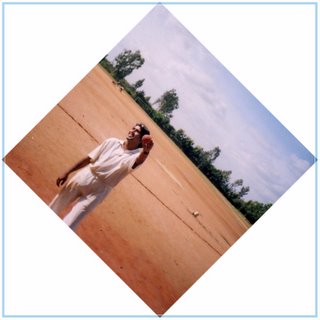
.....Its a quite old event, i mean its 3 months old event, before i broke my finger and before we faced all kind of problems. This was our first match in league and we won it as we had won the last one. These are the big stars of IISc cricket team, and the small stars are at the bottom. partha got 6 wickets and I scored 75 in that match. Most of the team performed in similar fashion in other matches but unfortunately Sandeep's camera couldn't catch them. Kapil the caps is not here. ViveK, Mahesh are also missing.
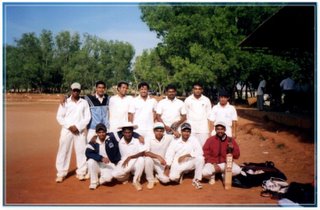
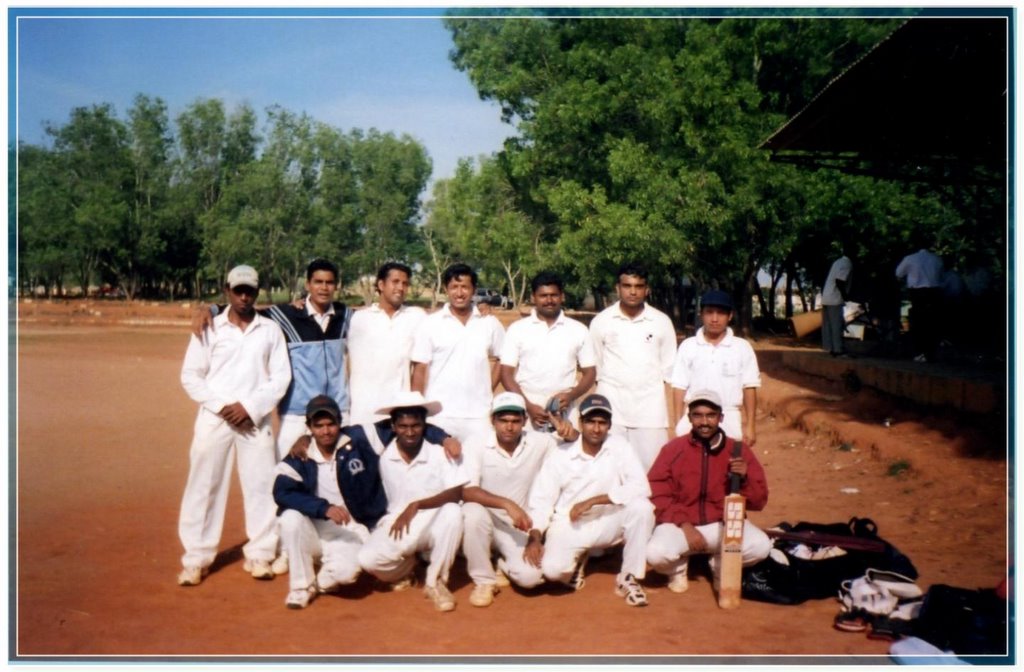
Srini, Sachin, Partha, Atul, Kumar, Venu (star faculty), Jackie (Santanu)
Sandeep, Uncle (Surinder), OP, Saru(Sarendra) and me
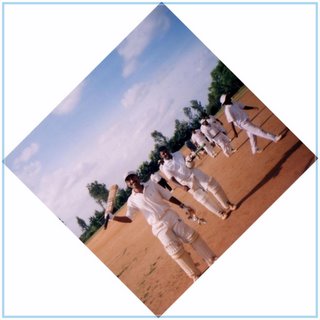
Sandeep, Uncle (Surinder), OP, Saru(Sarendra) and me
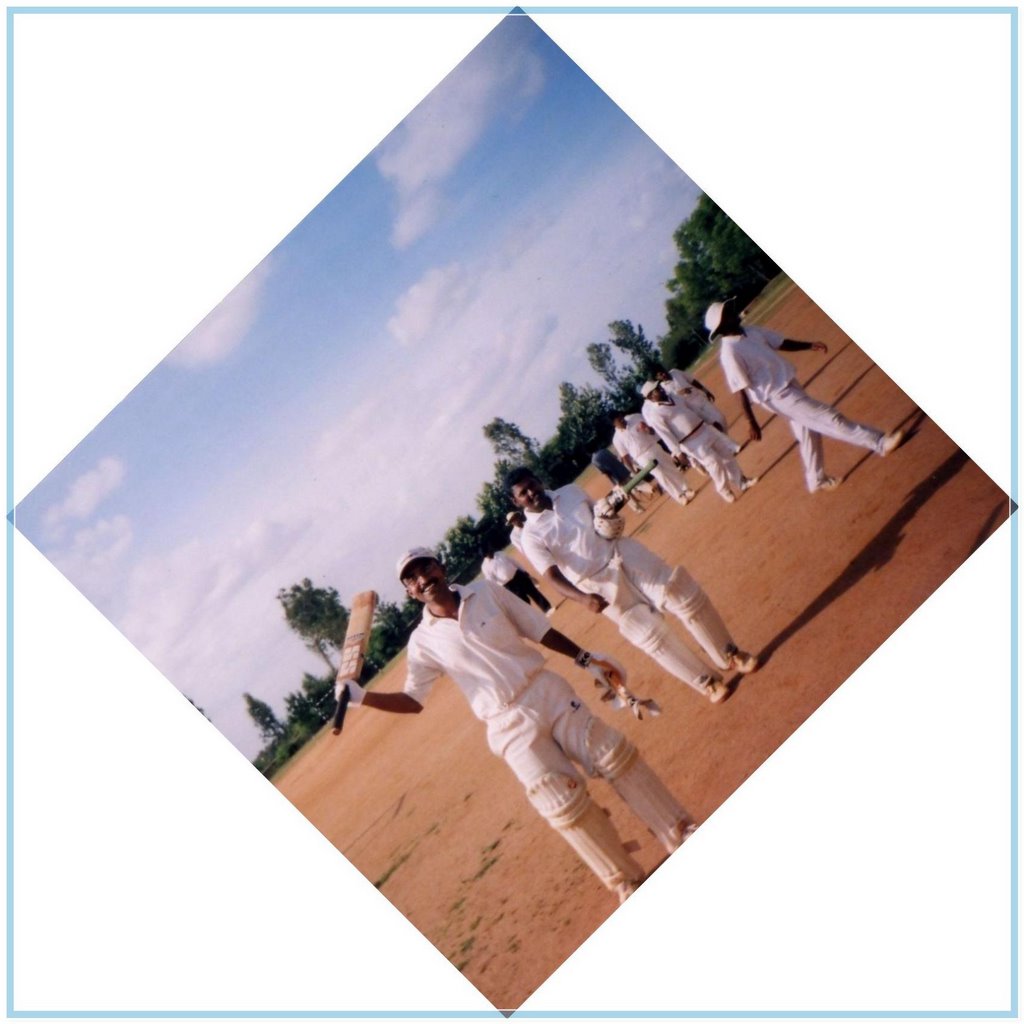
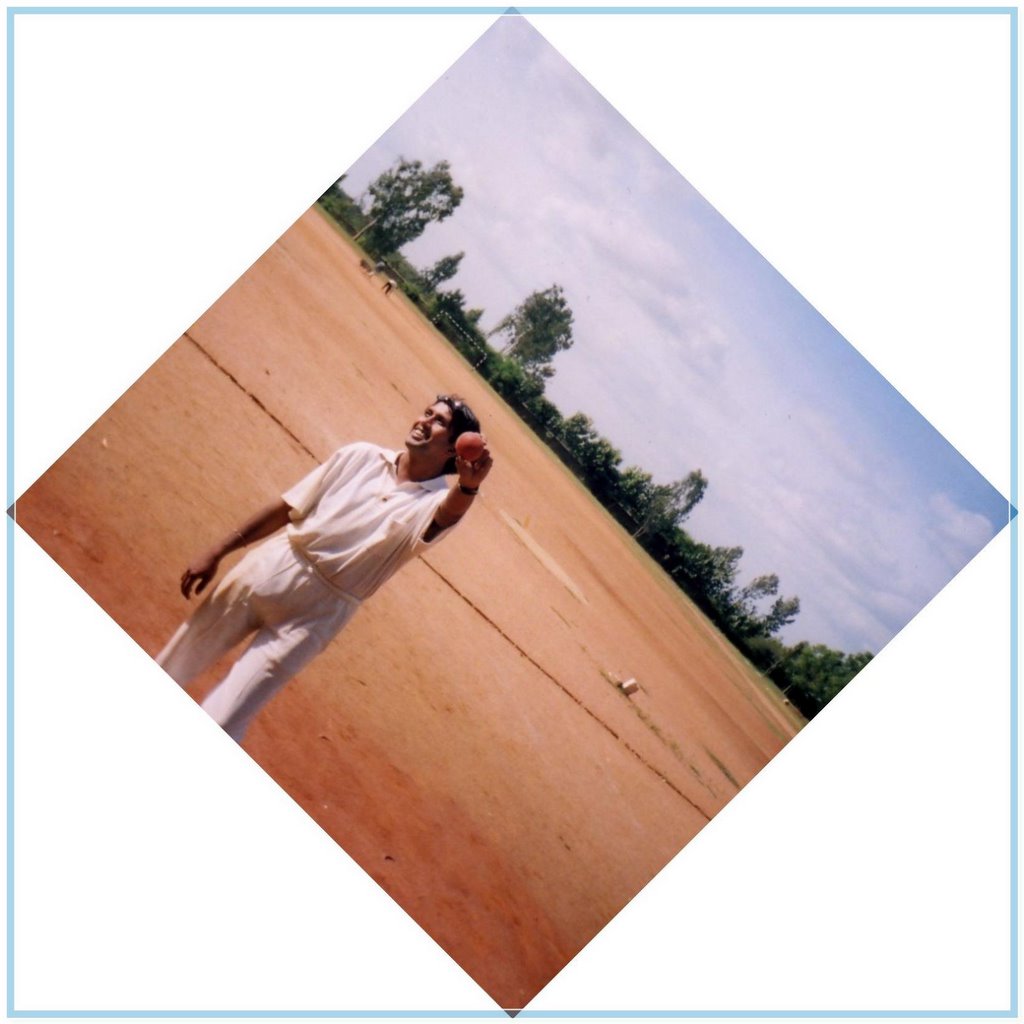
Me and Partha
Friday, December 02, 2005
in CHENNAI for NMD
I feel sometimes myself like the Shepard in Alchemist. Though I don’t dream about pyramids, but I always grab opportunities to visit places whenever possible. This time it was Chennai, and NMD-ATM, annual technical meeting of metallurgist from all over India. Along with the meeting I actually wanted to visit IIT-Chennai. So now I have seen two IITs. ATM followed FDM, the international conference on future of materials where Atul presented a paper, and I was fortunate enough that he had put my name in it! Thanks Atul! Before ATM I have to mention NMD because on that day Dr. Phanikumar got the young metallurgist award and I want to congratulate him.
I heard before the conference that ATM is a low profile conference, but was elated to find that a portion of the talks were really good. The participation was really huge, posters as well as speeches. A whole gamut from materials and metallurgical research came here. Truly speaking conference was very general and I had to find talks of my own interest. There were three parallel sessions. I was especially interested in the mechanical behaviour of materials, some functional stuffs and then Ceramics of course. I had attended few sessions on mechanical behaviour of materials. First day, 15th Nov. I found some interesting stuffs about Spark Plasma Sintering processes. ARCI is currently doing lots of work on that, with Dibyendu around I would also try something! Guru’s rafting was as usual good and I guess serendipity is knocking his door. There was a talk by Vendervort, the king of metallography and also days end Vikram mesmiriesed audience with a 10 min talk on wear. Second day it was bit hectic, as I wanted to attend the talk on metallic glasses, it was interesting session, Krishanu presented his paper on non-equilibrium solidifation which was good, better was his answers ( Dr. Dey, from BARC showed some beautiful HREM micrograph of the metallic glasses, again the controversy begun whether there is crystallization at the shear bands, Prof Ramchandra Rao, pioneer in the field was also present there. Rejin, hurried through his beautiful talk! Just for attending Vikram’s lecture, but his experiments for exhibiting Ductile Brittle transition was really good. Vikram was fascinating in his talk on the amorphous ceramics. Its really a magic material only requires good magicians like prof. Jayaram.It was more like our class room, but I wasn’t happy with the explanation he tried to give in support to the densification at high temperatures. The nano grains grow so fast, it is really difficult to differentiate between densification, creep and grain growth processes. I would be unfair If I miss the last talk which a girl from IGCAR delivered. They were using Infrared camera for strain measurement during tensile experiment. Not only the local strain it was possible to measure the stress distribution in the specimen, for large component which may be a good tool to use, but what I understood is that there are limitations in the shape of the resolution of the camera.
Its like writing a summary of Ramyana, I would have loved to describe each of the talks I participated but that’s some other time. What I really want is to thank all the faculty staffs and students, from IIT Chennai, life were really tough for them in that last week.
I heard before the conference that ATM is a low profile conference, but was elated to find that a portion of the talks were really good. The participation was really huge, posters as well as speeches. A whole gamut from materials and metallurgical research came here. Truly speaking conference was very general and I had to find talks of my own interest. There were three parallel sessions. I was especially interested in the mechanical behaviour of materials, some functional stuffs and then Ceramics of course. I had attended few sessions on mechanical behaviour of materials. First day, 15th Nov. I found some interesting stuffs about Spark Plasma Sintering processes. ARCI is currently doing lots of work on that, with Dibyendu around I would also try something! Guru’s rafting was as usual good and I guess serendipity is knocking his door. There was a talk by Vendervort, the king of metallography and also days end Vikram mesmiriesed audience with a 10 min talk on wear. Second day it was bit hectic, as I wanted to attend the talk on metallic glasses, it was interesting session, Krishanu presented his paper on non-equilibrium solidifation which was good, better was his answers ( Dr. Dey, from BARC showed some beautiful HREM micrograph of the metallic glasses, again the controversy begun whether there is crystallization at the shear bands, Prof Ramchandra Rao, pioneer in the field was also present there. Rejin, hurried through his beautiful talk! Just for attending Vikram’s lecture, but his experiments for exhibiting Ductile Brittle transition was really good. Vikram was fascinating in his talk on the amorphous ceramics. Its really a magic material only requires good magicians like prof. Jayaram.It was more like our class room, but I wasn’t happy with the explanation he tried to give in support to the densification at high temperatures. The nano grains grow so fast, it is really difficult to differentiate between densification, creep and grain growth processes. I would be unfair If I miss the last talk which a girl from IGCAR delivered. They were using Infrared camera for strain measurement during tensile experiment. Not only the local strain it was possible to measure the stress distribution in the specimen, for large component which may be a good tool to use, but what I understood is that there are limitations in the shape of the resolution of the camera.
home "together"
I was standing at the door of the compartment, while the train was slowly crossing the bridge over Krishna. Sky was full of clouds rain drops were piercing through my skin; I was really enjoying it as I was going home. It was dusk and Krishna looked beautiful, with water reaching from one corner to the other and the river met the horizon. I was standing at the door because my seat was occupied by some students from Ramaiya College; I tried to raise my voice but gave in to the teens. I didn’t sleep well in the night, not only because of the extravagant students but also for the unusual bed, but I didn’t complain, as I was going home. Early morning I woke up and the first thing that I heard was that the train is running late by 6 hr. Bad times were still sticking with me! The whole day my walkman was really helpful, the girls and the guys were enjoying a lot and making plans for diwali I found myself an odd man out, realized that I have crossed some stage of my life, but I was happy like others: we were all going home. That whole day I finished a book which “kotts” gave me mentioning that as a mediocre book, “interpreter of maladies” by Jhumpa Lahiri, it’s a collection of short stories and except the name story, I found most of the others quite good. Then came the last night in train, by the time it was running 8 hr. late. I remember one girl was traveling to Patna and she was going to miss her train from Howrah, it was such a helpless situation for her and her family that, her father started travlelling from Patna to Howrah to take he daughter along with him, it didn’t bother me much you know; I was reaching home! Finally the train reached Kharagpur, after a delay of 11 hr. It was a bright sunny day, finally a bright day, I don’t after how many days I was enjoying a bright day. Last four months it really poured heavily in Bangalore. My big bro rented a car and came to pick me, it was a nice time. My house is at a beautiful place called Jhargram, of course to me. This place is just 7 Km. away from my home.
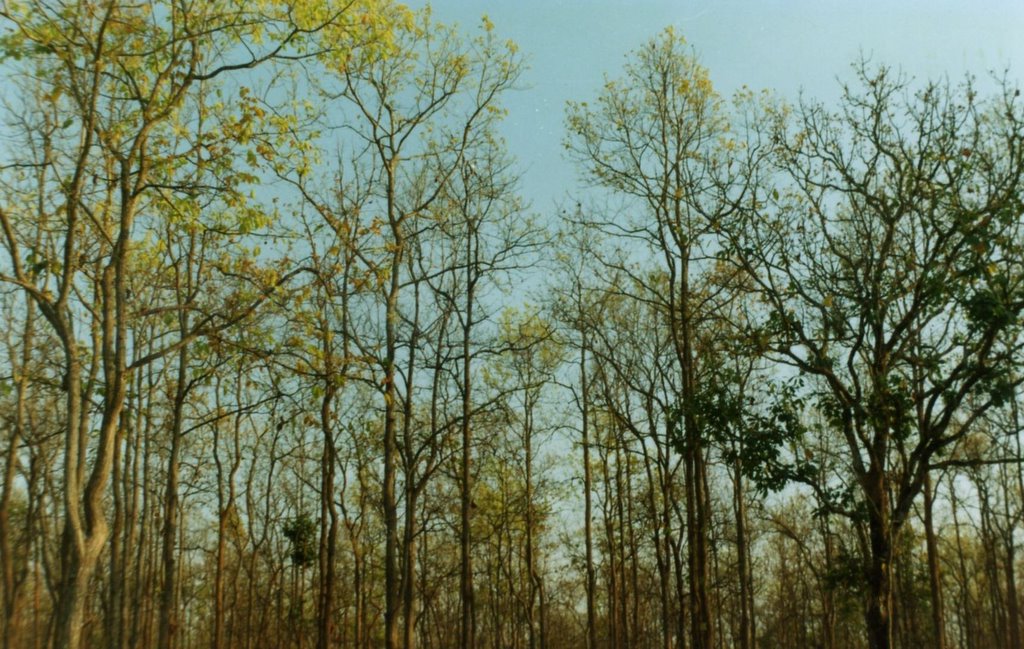
photo courtsey: My bro Debraj
I was really feeling great; Not only “dada”, Chiku also came along with him, we had a ball of a time in the car, and then after 47 hr. after leaving the lab finally I was at this place…

From bro's cell:appears bluish in reality not so much
No prize for guessing, yes! So I was at home !
After the break
I had compre and then I went home, and then I had to start working, where is the time for blogging :D. Along with this fact there is truth and the truth is I was lethargic, but came back powerful.
Tuesday, October 11, 2005
thanks Stuts!
...i know u'll no c this! but this the only way probably i can thank you :). I finished my compre today.
Tuesday, October 04, 2005
grain size refinement in the nano range
The title sounds too technical, but it will go this way as my compre is nearing and I am reading up few things which I thought would put down.
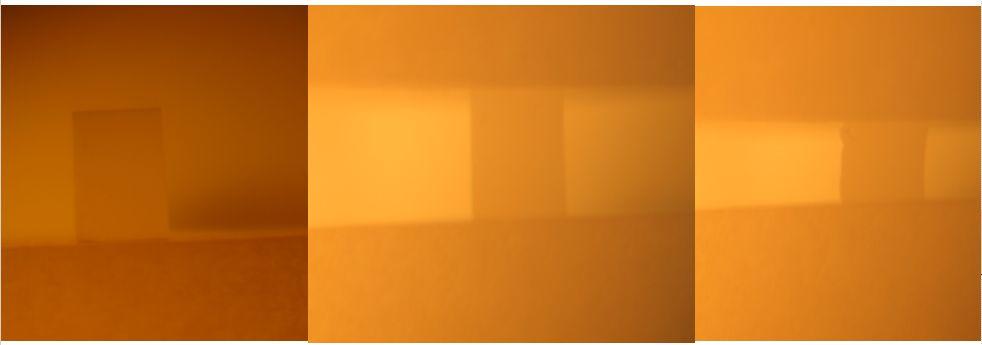
In the end of 20th century people could easily achieve grain sizes in the sub-micron range (<1 micron) in zirconia ceramics, but it wasn't sufficient; there was a strong driving force to refine the grain size to nano range (< 100 nm) of course for obtaining certain advantages, mostly enhanced structural and physical properties. Beginning of this century observed a difference in mechanical behaviour in nano-grained tetragonal zirconia from the sub µm grained one. This drove scientist to study this mechanical behaviour of nano zirconia whether it is tetragonal or monoclinic. Now the problem associated with density. It was not so difficult to achieve a grain size which is in nm range but with a density as high as 99% of the theoretical density, it was difficult. Currently there are few techniques which satisfies both requirements. Spark plasma sintering (SPS), Microwave sintering, Sinter-forging, HIPing, also the brand new one is crystallization from glass!In the first two processes control grain size is very limited and the sintering mechanism is still not completely understood. In SPS there is a huge current of the order of 1 kA and more is passed through a powder compact and it claimed to form plasma which sinters the material to full density very fast with a very small grain size, but with very little control. In the microwave process, both electric and magnetic field interact with the material, and the absorbed energy actually leads to very fast sintering, again microwave, though, is in industries now, and still is feeding significant no. of researchers around the world. This leaves us with Sinter-forging, an excellent processing technique which was first opted by couple of groups, Rehemans’ and Raj’s, in mid 80s. At high temperatures without any wall constraint if a compact under load is sintered, the sintering rate is enhanced by couple of factors; one is the stress induced diffusion becoming faster and disappearance of big pores by plastic deformation. In zirconia it was observed that instead of the applied stress actually the plastic strain controls the densification. Now here the advantage is that, one can independently play around with two parameters; stress and temperature and you can achieve grain size really in the nano range in a fully dense material. The pictures below are from sinter-forging experiments. One needs to monitor the transverse strain also along with the axial strain and in these experiments, for this specific experiment I used a digital camera in my I.I.Sc lab. These images were taken at 1423 K. Extreme right one is from the final stage of sinter-forging. You may notice that there is very little strain in the transverse direction compared to the axial direction, which indicates densification. I did not put the scale which is a “crime” but take it from me; the height of the specimen is 3.5 mm.

So now we have a nano-grained material, but what is the size? It is difficult to push the grain size of the bulk dense body below 50 nm, this is one shortcoming of sinter-forging. So here comes glass. The idea is like this: you take these oxides to very high temperature and cool it with a cooling rate of the order of 103 to 104 K/min and they may form glass or some amorphous phase, and now if this glass is taken above the transition temperature, the crystallite starts nucleating and the body becomes a dense nanocrsystalline body with a crystallite size may be as low as 15 nm. This processing technique is difficult and there are critical issues involved with density, still it gives you the grain size you want. What else, if I have such material (from 15 -100 nm) in hand, a through mechanical property study is possible. Then I know serendipity will knock my door any day and I will jump and shout…………:D
In the end of 20th century people could easily achieve grain sizes in the sub-micron range (<1 micron) in zirconia ceramics, but it wasn't sufficient; there was a strong driving force to refine the grain size to nano range (< 100 nm) of course for obtaining certain advantages, mostly enhanced structural and physical properties. Beginning of this century observed a difference in mechanical behaviour in nano-grained tetragonal zirconia from the sub µm grained one. This drove scientist to study this mechanical behaviour of nano zirconia whether it is tetragonal or monoclinic. Now the problem associated with density. It was not so difficult to achieve a grain size which is in nm range but with a density as high as 99% of the theoretical density, it was difficult. Currently there are few techniques which satisfies both requirements. Spark plasma sintering (SPS), Microwave sintering, Sinter-forging, HIPing, also the brand new one is crystallization from glass!In the first two processes control grain size is very limited and the sintering mechanism is still not completely understood. In SPS there is a huge current of the order of 1 kA and more is passed through a powder compact and it claimed to form plasma which sinters the material to full density very fast with a very small grain size, but with very little control. In the microwave process, both electric and magnetic field interact with the material, and the absorbed energy actually leads to very fast sintering, again microwave, though, is in industries now, and still is feeding significant no. of researchers around the world. This leaves us with Sinter-forging, an excellent processing technique which was first opted by couple of groups, Rehemans’ and Raj’s, in mid 80s. At high temperatures without any wall constraint if a compact under load is sintered, the sintering rate is enhanced by couple of factors; one is the stress induced diffusion becoming faster and disappearance of big pores by plastic deformation. In zirconia it was observed that instead of the applied stress actually the plastic strain controls the densification. Now here the advantage is that, one can independently play around with two parameters; stress and temperature and you can achieve grain size really in the nano range in a fully dense material. The pictures below are from sinter-forging experiments. One needs to monitor the transverse strain also along with the axial strain and in these experiments, for this specific experiment I used a digital camera in my I.I.Sc lab. These images were taken at 1423 K. Extreme right one is from the final stage of sinter-forging. You may notice that there is very little strain in the transverse direction compared to the axial direction, which indicates densification. I did not put the scale which is a “crime” but take it from me; the height of the specimen is 3.5 mm.
So now we have a nano-grained material, but what is the size? It is difficult to push the grain size of the bulk dense body below 50 nm, this is one shortcoming of sinter-forging. So here comes glass. The idea is like this: you take these oxides to very high temperature and cool it with a cooling rate of the order of 103 to 104 K/min and they may form glass or some amorphous phase, and now if this glass is taken above the transition temperature, the crystallite starts nucleating and the body becomes a dense nanocrsystalline body with a crystallite size may be as low as 15 nm. This processing technique is difficult and there are critical issues involved with density, still it gives you the grain size you want. What else, if I have such material (from 15 -100 nm) in hand, a through mechanical property study is possible. Then I know serendipity will knock my door any day and I will jump and shout…………:D
Subscribe to:
Posts (Atom)