Saturday, August 26, 2006

nano2006:Day III

Crowd on Wednesday morning was less compared to last couple of days, and I knew that those who didn’t turned up missed something. Prof. Subra Suresh delivered a fascinating lecture today. He is an engineer who is too much inside microbiology and his talk primarily focused at making things better microbiologists through nanomechanics. He talked about basically couple of cells, first one is red blood cell and the second one is cancerous pancreatic cell. Malaria parasite, plasmodium falsiperum which attacks the red blood cell, increases the stiffness and makes the cells sticky hence causes blockages in the vein. He showed the change in stiffness in tensile tests conducted using optical tweezers. The interesting point was to remove an antigen called RESA from the parasite and exhibiting reduction in stiffness, which is desired for these cells. For cancerous cell he observed just the opposite trend and its his ongoing project. By far his talk was most exciting for an engineer. The second talk was delivered by Prof. AK Sood, his name rippled the campus when he got his paper in science. Although focus of his talk was electron conduction through CNTs, he discussed a part of his old work. They passed pure water through a nanotube with an inner diameter of 1.4 nm and observed a suppression of freezing point of water upto -50 oC. Later he proposed that it’s a single chain of water molecule which becomes supercooled, great work. The second phase of his talk was mostly on measuring the electron transport through the tube and also attaching particles like Pd to the tubes for better electrical property, also he talked a bit about the application on nano rods for optical tweezers. So I got to see 3 different optical tweezers in last 2 days. I missed the rest of the sessions as I need to consult the doc in the morning, my poor knee! During second half I had plans for attending few talks; I started with Dr. G. K Deys’ lecture, his grp. in BARC does quite a bit of TEM and here also he presented the work on Zr based BMGs. Good microscopy and followed by the age old question whether there is crystallinity in the shear bands, answer from him was no. I wanted to attend Rachman Chaim’s lecture but he did not turn up. Dr. Wang’s talk on insitu TEM was exciting as much as other in situ experiments that excite me. I had to Rush because today I had my poster presentation. My work was on low temperature creep in YTZ, I had some new stuffs there, couldn’t get good crowd to explain them . I had couple of productive discussion with Prof. R. Andrievski and Prof. Hahn. There few issues related to electron microscopy and grain boundary segregation came up during discussion. Altogether it was a nice couple of hours. I couldn’t get much opportunity to go through other poster though, Prasads’ work on nano Ni drew quite a bit of attention and curiosity. This brought us to the end of the poster sessions in nano2006. In the evening there was a dance program and since I am quite culturally challenged successfully skipped it! The dinner was excellent, people boozed more than yesterday, fortunately there was to trouble today trouble makers were identified and surely some nice surprises were there for them.
Wednesday, August 23, 2006

Prof. Nabarro no more

...Its quite sometime since the incident happened, Prof. Frank Regiland Nunes Nabarro the undisputed authority of dislocation theory passed away in a hospital on 20th July at the age of 90. Almost everyday we talk about Nabarro-herring creep and duing this nano 2006 many times the name came. Titas, who was collaborating with him gave me the news recently. Prof. Nabarro came to IISc this year and spent few days in the campus, he appeared a strong willed person even at the age of 90. He worked in University of Witwatersand, Johanesberg for 53 long years.....

nano2006: Day II

Second day started with a usual busy note, the main hall was filled before nine and just over nine there was a decent crowd inside. The morning sessions began with couple of plenary lectures. Two stalwart from Japan, Prof. Inoue and Prof. Aono set the day for the participants, physical metallurgy and functional materials became more interesting from morning! Prof. Inoue the pioneer in bulk metallic glasses talked about lanthanide based system and also the true bulk glass with diameter of 100 nm. Prof. Aono discussed nanowires and primarily the CNTs. I had to attend the talks under theme B, the first invited talk was by Enrique Lavernia from UCD on the cryo milled nanostructured materials, a novel technique to form nano grained Al, Cu. He talked also about the high ductility of the material with bimodal microstructure, nano metals is moving towards this direction, yesterday Prof. Mukherjee and Prof. Valiev had talked about it and today Enrique. Ruth Swaiger from FZK had something different to talk. It was the grain growth in the edges of the nanoindented Ni, there were many questions about the process but she threw the idea of athermal, stress induced grain growth in these materials. Prof Rodriguez talked about the Hall Petch and inverse Hall Petch relation. I wanted to attend a talk on the nanoporous alumina protein bio markers, unfortunately the speaker did not turn up! Today the conference got true colours, the colorful pics from the mixture party and poster session yesterday came today. Today was also the day for making new contacts, well I got to know few people and there were more going on, of course it is a rare opportunity of discussions. The second a session started with a talk by Uwe Erb, he talked about the thermal stability of nan Ni, in my lab Prasad and Ravi had already worked with this material, they were quite thick plates, the concern is with sulpher content. The second talk I attended was by Rajesh Kumar a grad student from Punjub Engineering College. It was on optical tweezers. I did not know about the technology and was curious to know. They were using mysine and was passing a laser through the molecule in the fluid. From the image analysis they were figuring out the parameters, it was quite good piece of work. The could measure load as low as 0.3 pN and a displacement of 677 nm. Prita Pant in the structural materials section talked about modeling of dislocations dynamics. Kartik almost had a discussion with her during question answer sessions. Poster sessions was quite enriched though I did not have much to get from them still had quite good discussions with Rejin on his work on hydroxyapatite, on carrying out indentation on non basal planes. Arindam also had a nice poster as well as Dibyendu. Kotts got quite a bit of crowd for his poster. There were much on functional materials but I couldn’t pick much from them. Tomorrow I have my turn to present my poster.
Evening was the banquet time, good food nice drinks and nice ambience had great time with friends from the dept. and Abi! The torch for nano2008 was handed over to Rio De Janeiro also today evening and now time to talk about some unfortunate events, some “Indian scientists (!!??)” who were being put up in NIAS guest house behaved so badly with me and my few juniors that it almost took me to my undergrad days, it was surprising how mean people can become, anyway I felt very bad because these people are testing the patients of my colleagues everyday day and night. Do we really need everyone to run a conference? Hats of to the guys carrying out transportation job, looks like more pains are still there.

Tomorrow morning session and afternoon sessions

Tuesday, August 22, 2006

nano2006: Day I


Yesterday there was an indication and today it was a reality. The 8th international conference on nanostructured material started today with a bang! We anticipated the no. of people going to turn up will be quite large and it was evident from last night attendance in the mixture party, more than 450 delegates! The conference was inaugurated at 9 in the moring and J. N. Tata Auditorium was just packed. Many of the big guys talked about nano science and technology and theme of the in augural session was of course anticipation for a productive 5 days ahead. Prof Balram, Director of IISc emphasized more on interdisciplinary research and agreed that he really have tough time in bringing science and engineering department together. Although his last statement, which did not make me elated’ was that chemistry in the key for nanomaterials. Mr. Director its material science and physics, maths and bio is now equally important brothers. The first plenary lecture was delivered by the pioneer in nano research Prof. CNR Rao, Prof. Ranganathan introduced the only Dan David fellow in India. Prof Rao started his lecture by describing an oxide which behaves as a metal (ReO3) at nano stage. His talk was concentrated more on the nanotubes than any other properties, the innovative work was to form thin films at the liquid-liquid interface. This lecture set the tune of the conference, but still it was started with the chemical note. There is little doubt that Atul and Kamanio really had tough time making this big event a reality, the way our faculties slogged for last few months was really impressive. The sessions I followed and will be following is taking place in the J. N. Tata audi, and few talks I will attend in bio materials and few in the functional material sessions. I am not going to Satish Dhawan audi where the theme D talks are going on. CNR’s talk was followed by the talk by Ruslan Valiev in structural materials session. He talked about the SPD process, the interesting part of his talk was to describe the amorphous phase that formed in Ni during parallel channel ECAP, Vikram rightly added issue of grain size dependence on the amorphization. Prof. Amiya Mukherjee’s replaced Helena and gave a very stimulating talk. Highlight was the strength of Cu and the Si3N4 with toughness nearly 15??!! Rightly the work reached Nature. The talk on Biomaterials in the hall c in the afternoon session was also quite informative for people who are new to this field. Prof Yang stressed on the nano ceramics required for biomedical application. I missed the last talk by Ramu, he is in a new field and quite happening one: it was the SWNT doped nano composite for high mechanical strength application. Prof. Mukherjee’s talk gave us the information that the CNT fibers have strength of 1 TeraGPa!!! It appeared to me that this nano will be dominated by CNTs; last nano2004 surely paved the way for CNT technology for this one. There were tons of posters there; I was looking for few guys who did not turn up. like Takeli, anyway it had few very good works to go through. Whether it is Krisanu’s HREM or the scientist's work from TIFR, had shown that nano materials are in the heart of technology today. Let’s see what day 2 unfurls, by the way, Abi’s hall management gang or the guys in the registration were quite sharp today, but extra credit goes to the people taking care of transportation they are having a tough time, i hope situation changes tomorrow.

Monday, July 24, 2006

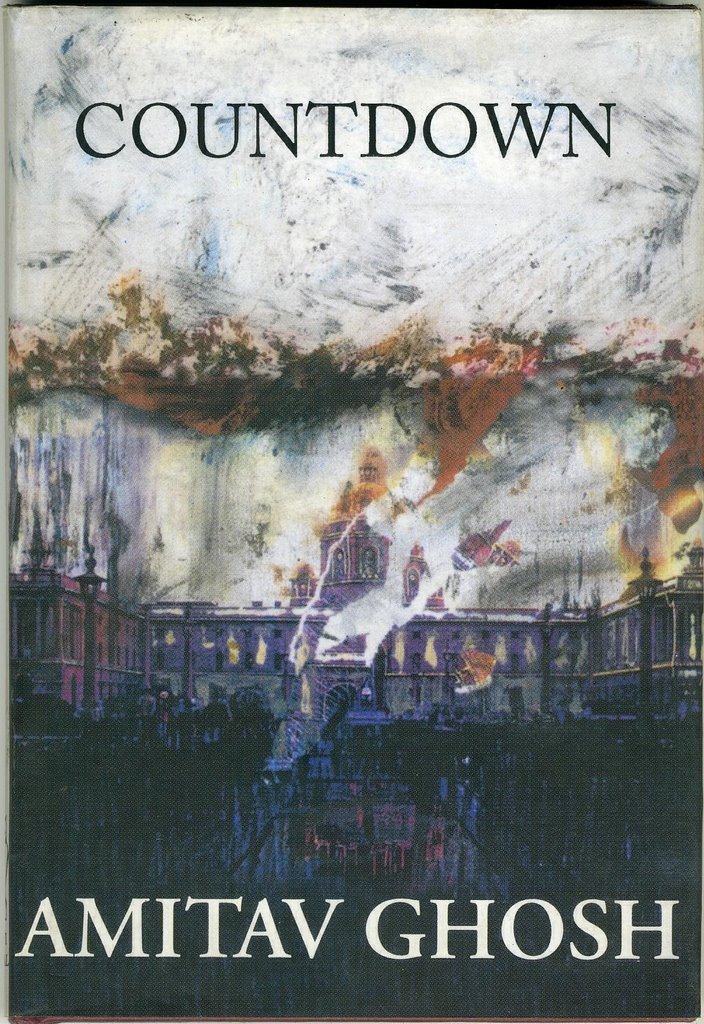
An anniversary and " The countdown"

I started this blogging journey just a year back. It was really a different experiment. though it was not the first time I was writing something, it’s a childhood habbit. One striking similarity between that writing and this writing is that both were an open source essays! Yes my childhood diary which i still carry with me was corrected by one of my teacher! Although he had only academic interests but still is was accessible by any one around me. This one is no way different; I tried to write different things in different moods. The 40 posts I have are different, so lets start repeating it. My first post was a few lines on one of my favourite book "we the living" and today i want to write few lines about a book from my another favourite author Amitav Ghosh.

...........This is one of Amitav Ghosh's books which I think was not' read by many readers, like they read "Shadow lines", "Dancing in Cambodia...” or "Hungry tide...” The book I am talking about here is "Countdown". Amitav Ghosh wrote about many countries and civilizations and I found the anthropologists view is evident everywhere. I was curious how he would have described the relationship between India and Pakistan where emotions flow like river both for hatred and friendship, but there is surely a neutral view and Ghosh represents this in an outstanding fashion. This article is written just after India and Pakistan have carried out their respective nuclear tests. This book was an outcome of Authors travel in both the countries after the explosion. He interviewed many people both in India as well as in Pakistan. He begins the essay by describing the political scenario in India as well as in Pakistan. In India BJP was in power and this was for the first time when a not so secular govt. was in power, whereas in Pakistan, Nawaj sharif was planning to get away with the conventional law and implementing religious laws, in this changing environment these test carried lot of significance in the subcontinent. Although Ghosh never hid his views against the nuclear tests still he never showed any bias towards his views. There were couple of interviews around which the article grew, were excellent. One is with Mr. George Fernandez, then defense minister of India and Asma Zahangir the noted human right activist from Pakistan. The political and social background of these two persons actually was very helpful in understanding the views they expresses Amitav Ghosh is really good at that. Both of these celebrities expressed a common concern about the deterioration of the values and death of the ideas followed by these two countries. It came to me with a little surprise that the view towards nuclear weapon is very different in India and Pakistan. In India people see nuclear weapon as a symbol of strength which will never be used whereas in Pakistan there is a real anticipation of a nuclear war. This is how Ghosh had envisaged attitude towards nuclear weapon, but when I read the news today that Pakistan is piling up 20 times more nuclear war heads per yr., its sounded like Amitav Ghosh was quite right in understanding the pulse of both the views. The last part of the book is something I never thought author will address: the devastation that will follow a nuclear attack on Mumbai or Delhi, a chill passes through your spine when you imagine the devastation foreseen by the scholars . It has been beautifully explained with all scientific support. This book is as good as the other creation by Amitav Gosh. Salute to him.

Thursday, June 08, 2006

Nostalgia

Our T-board gang is almost non-existent now. Guru was the last man standing and he left today. We had a big gang comprising of 12-13 people, with our fixed 2 p.m. and 10 p.m. T at the T board. I may not recall all the names but lets try, It was Shankara, Phanikumar, Sudhir, Phaniraj, Sarvavanan, Krishanu, Guru, Kottada, me, Basa, Ln(rao), Manas, I am sure I forgot few. Extreme weather or tremendous workload could not alter the schedule for a single day. Even during student’s symposium days we used to find 5 min for the T. I remember Shankara used to sleep for 2 min if the time at the clock wasn’t showing 2 p.m. sounds crazy right, that’s how grad students act. The discussion at the T-board used to be pretty much informal, and at times there used to be a technical discussion. Boy, I am sure that must be one rare opportunity to see the beautiful minds at their best. Honestly speaking there were much technical stuff which I picked up from these sessions, but interesting was gossips, they were really hilarious! I won’t divulge who used to crack what kind of joke but they were really some enjoyable moments. Change is the name of life and there is always something better happens all the time. I am sure this will give away opportunity for different people among us to come together and form a new fresh group. Renowned singer Manna Dey has a famous Bengali song on "coffee house"; I am trying to translate the last few lines:

“… Those seven chairs and the table are still there, even the cups are also not empty; new buds have come in the same garden only the old gardeners have disappeared…”

Best of luck mates we will share a cup of T again :-)


All smiles!!!

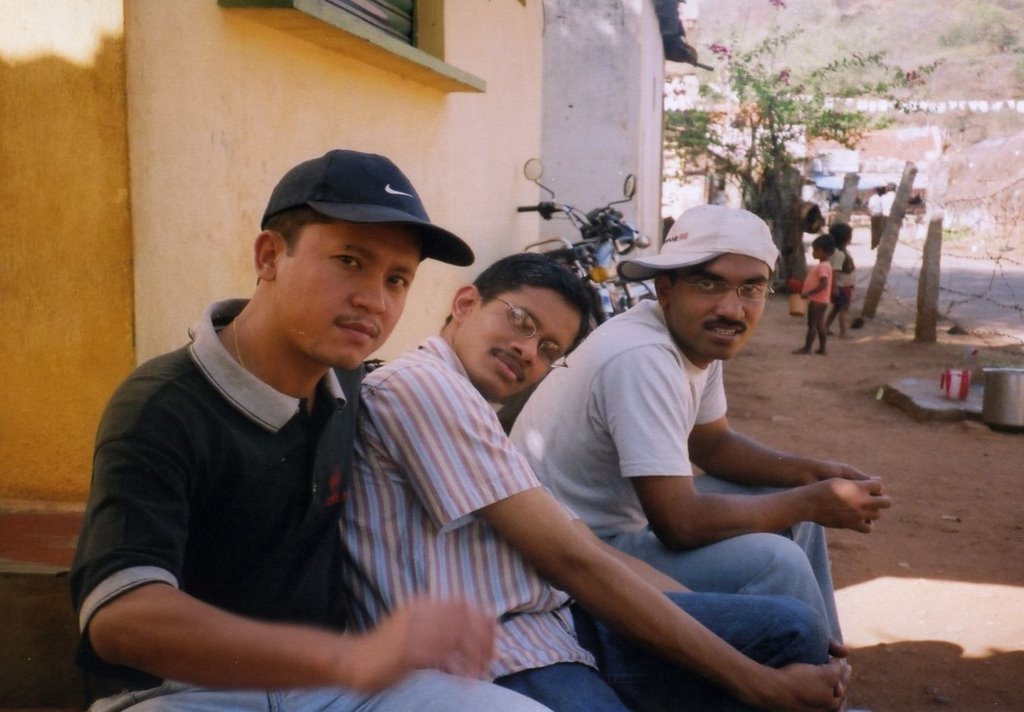
From left: Ln(rao) in Mcgill Univ Canada, Sahoo in Japan, Basa in Leuven, Belgium, Kotts in Karlshrue Germany, Saswata and Me right here, Guru will be in Northwestern USA, Sudhir is in Boulder USA.
The tree in the background has also disappeared from the T-Board

Wednesday, May 31, 2006

Ek doctor ki maut.......

People say when grad students talk you can summarize the whole conversion as a collage of complains! Well sometimes i do similar things but i didn't want my blog become a complain book, coz I am sure after a year or two they will sound extremely silly. So i will scribble something different than what I was doing. Reading a person like a book is something I do regularly, and I feel it’s harmless as long as I am not disturbing anyone. Before I deviate more I should say that I am feeling like writing about some one.
Recently, Anandabazar Patrika wrote an article in editorial page, it was on a marriage! I was surprised that a news paper like that is covering marriages!!! and later cursed myself for my ignorance, I came to know that it was the marriage of Kanupriya Agarwal,“durga”, the first test tube baby of India. Her birth was a scientific experiment with a huge scientific importance and the persons who carried it out was Dr. Subhas Mukhopadhyay and his group. His group consisted of doctors with a potential, but I will write only about Dr. Mukhopadhyay, who passed away just 25 years back. He was a pioneer researcher with great achievements committed suicide on 19th June, 1981. Who is a test tube baby? In short a baby who was born through a technique called in vitro fertilization in medical terms. In this technique eggs are fertilized outside woman’s body, at the beginning it was really a tricky experiment . The first “test tube baby” was Marie Louise Brown. Dr. Patrick Steptoe and Dr. Edwards’s successful experiment gave birth to Marie on 25th July, 1978, but was that really first? Scientific world is a cruel place, Dr. Subhas Mukhopadhyay and his group brought the first test tube baby to the world on 3rd October in the same year, just 67 days later! Those who have worked in Kolkata knows why it was an achievement, the follow up incidents proved this more evidently. Both scientists faced stern criticism, for Dr. Mukhopadhyay it was not the world, because this news never reached the world. Outside India it was Dr. Indira Hinduja who was the first Indian to perform IVF in 1986, which have birth to Harsha in Bombay. This was a documented fact till the beginning of the 21st Century. Why he was not given the credit? I don’t know how many people really know why this happened or what really happened? Unlike Dr. Subhas Mukhpadhyay, in spite of criticism the British scientists could carry out more successful experiment and published their work. West Bengal government took few very surprising steps and banned his research. He was due to attend a seminar in Kyoto University in 1979 which also he was not allowed. The only published document of this work was a report, submitted by Dr. Subhas Mukhpadhyay to the government of West Bengal, as he was instructed to do so. This document carried very little data as it was not a scientific report. He wanted to carry out further experiments to establish the technique but the government prohibited him from doing any kind of research in that field. They were not satisfied with this, they transferred him to an eye hospital that did not have any facility to carry out such research. This was a huge loss since the technique Dr. Mukhopadhyay used was different from the one from the British group. This must have been a testing time for his family and him, the medical research community in Bengal was also not very friendly to him that time and these lead him to commit suicide in 1981. This would have been the end of the story, but it was not. His friends and colleague such as Dr. T. Anand Kumar, fought for his right then on. This whole event reached the ear of masses through Dr. Tapan Sinha’s outstanding movie "Ek doctor ki maut" in 1991. This movie was based on Dr. Mukhopadhyay’s life and received applause from all corners of the country and the world. In the year 2003, British medical council celebrated the silver jubilee of this event in a grand fashion, and this fortunately during the same period Dr. Subhas Mukhpadhyay got due recognition. In October Indian Council for Medical Research and National Academy of Medical Sciences accepted Mukherjee as the ‘first’. In the Indian Academy of Science premises in Bangalore they felicitated his group members along with Kanupriya. It was recognition which took a long time to come. This was really a sad incident for Indian science since this was a discovery with immense scientific importance, till now a million people have born through IVF technique!


Links:
Current science

Saturday, April 01, 2006

I know a photographer!

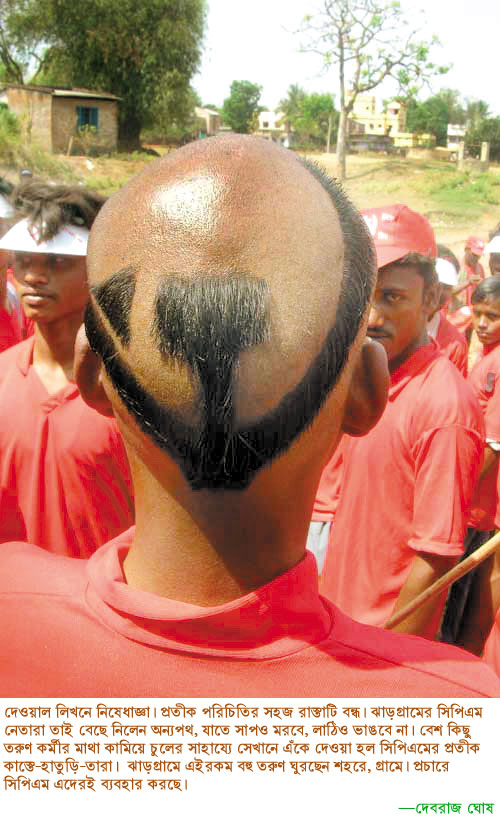
So I know a press photographer now! This picture is from a front page of a popular Bengali daily called “pratidin”. After the Election Commission ruling that political parties can not campaign by wall painting for the up coming assembly election on 17th April in west Bengal, the parties are getting innovative ideas this is one of them. One guy has shaved is head etching out the symbol for some party. The sign is sickle hammer and the star


Photo courtesy “pratidin” 30.03.06
Okay, I am putting it as my brother took it. He wasn’t a pro but I think he has become one since his work is appearing at the front pages of the news papers; well done bro, keep it up…

Tuesday, March 28, 2006

a new look! finally

Finally our institute paid attention towards our web page. A new IISc web page is up. I dont know whether i am late to notice it but just now i noticed it. The facade is good! Lots of infos which were hidden inside the old page are now one click away. I liked the limk for ejournals appearing in the front page. More or less its good. I will dig up some more stuffs soon, but did you notice something; in the top corner of the page some games pic appearing. In the cricket pic some lefty batsman is hitting the ball to somewhere, guess who can it be.......... :-D

Sunday, March 26, 2006

Problems in Data Acquisition

Digital data acquisition systems have changed the world a bit! Simulated flight training, cars controlled by automatic systems are reality now. Present day research also exercises a great deal of importance on data acquisition systems. When I look around the characterization tools we use, I found most of the machines are computer controlled and I witnessed analogue to digital transition for quite a few equipment. We have our old Scanning Electron Microscope which has all the controls as buttons or knobs. Whereas, the new SEM we got has all these controls but it’s a mouse click away. One of our distinguished faculties had one mentioned that a trained Chimpanzee can operate these machines with its little finger. Surely data acquisition systems has became integral part of characterization, we no longer sit in front of DTA machine and note down the data for hours, it’s a software which does this, but here is the hitch: Data acquisition system (DAS) can easily put you in trouble if you aren’t careful. For sensitive systems which deal with high pressure or high temperature DAS needs to extremely good otherwise it may lead to catastrophe. Let’s first know where we go wrong most of the time. DAS includes four components: transducer, signal conditioner, data acquisition cards and of course the beautiful softwares. Many of us think that transducers are not a part of it and our control will be better if we have a better DAS, but in practice, the whole DAS is as good or as bad as the transducer is hence the first thing that comes into picture

1. Transducers and actuator are integral part of the DAS and a better control is possible only when a good transducer controls the machine.

2. After transducer it is the turn for the signal conditioning unit. One important feature is where to put the signal conditioner? It needs to be near the transducer as the noise is low at this point. In this regard second important point is the cable. The DA board uses similar connector as the some other ports/boards, but the design will be completely different. We have a tendency to use same connector for all application which may at times become very risky. A system should have a shielded cable in order to reduce the noise level. Wiring is important, its better to check the connection twice before starting the acquisition.

3. I will discuss ignorance here. We do data acquisition from both grounded and ungrounded sources. In case grounded source we assume our ground is at zero potential, which may not the case. Moreover, if you use transducers grounded using different ground with different potential, the data which we are acquiring will be highly erroneous. In case of low voltage measurement its quite a problem, your machine may stop working for such small problem. The punch line is use same ground for all the transducers and make sure it’s a zero potential.

4. Aliasing was one of the problems with DAS. According to Nyqist theory if signal has no frequency component above ½ the sampling rate then the signal can be completely reconstructed, and if there are frequencies above that the data will be corrupted. In practice the complete set of frequencies aren’t free from higher frequencies but there are ways to handle it, but if it goes beyond a limit it’s a problem. Suppose you are using a sampling rate of 300, and reconstructing a signal with frequency of 10 Hz, the system is absolutely fine but is its 280 Hz, well it can not show anything, that’s good but you will get a wrong result when its shows a value of 20 Hz. You have a completely wrong info. The soulution is not difficult and most of good DAS systems have this protection, a low pass filter before digitization is enough to reduce the Nyquist frequency effect, and present day most of the companies take care of it

5. Softwares! They are beautiful with all kind of flexibility to analyze the data acquired and present them in beautiful plots. The problems are in disguise, be very careful in using them and don’t belive the information you are getting without verifying it. These programs are good, but many a times they won’t consider the complexity that is hidden in your system, hence analyze the data in a wrong fashion. Its sound very general and more like software haters speak, but it is really important. Now-a-days DAS companies come up with very good softwares, still there are always ifs and buts.

I could remember few of the issues related to DAS, but there may be more and comments regarding this are really welcomed, as far i am concerned, I felt like putdown this issues.

Some interesting old articles are here:

Mistakes in DA

Article by Strether Smith


Tuesday, March 14, 2006

A day out to Muthati

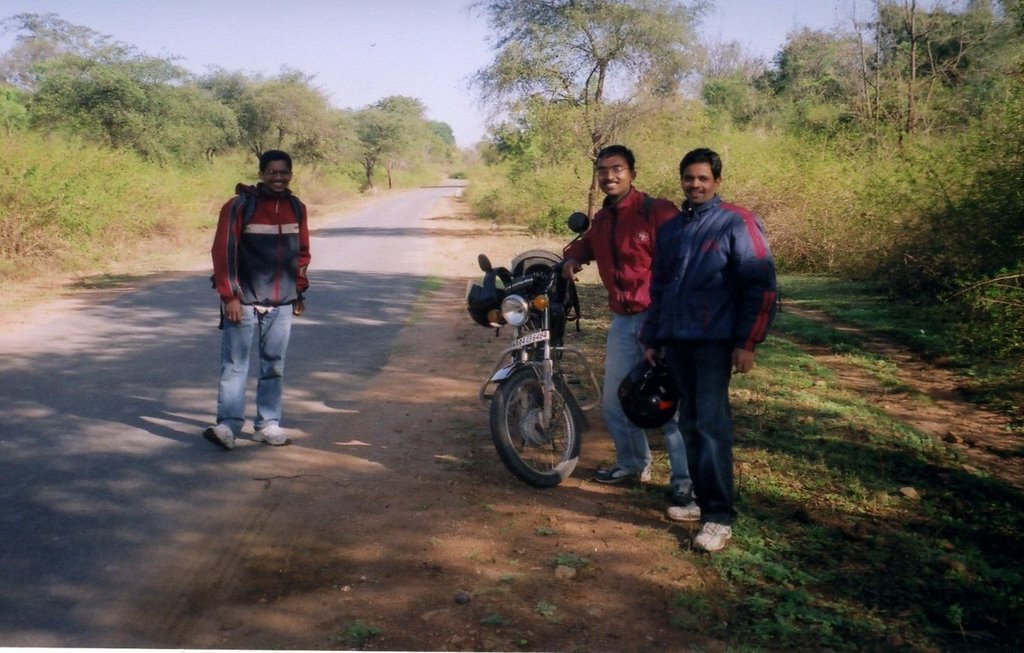
Last october when Kotts was leaving for Germany, we had decided to go for a trek while he is here in March, the plan was almost spoiled but somehow we pulled out a trek to Mutthatti. We found this place through Karanataka forest dept. trekking web page. This is one of the trek places which are being explored after the death of Sandel wood smuggler Veerappan. Though it was a two day trek, we wanted to cut it short by one day. In order to save the time we went by bike. Four musketeers: Kiran, Me, Kotts and Jackie (santanu) were there for the trek, Galavalli was the only one missing (he is enjoying in US) from the group went to Narasimha Parvata last April. We sorted out our plans the previous day; reaching Muthatti was not much of a concern, only concern was biking back to Bangalore and hence we had decided to come back before Dusk that left us a trekking time of 6 hr.
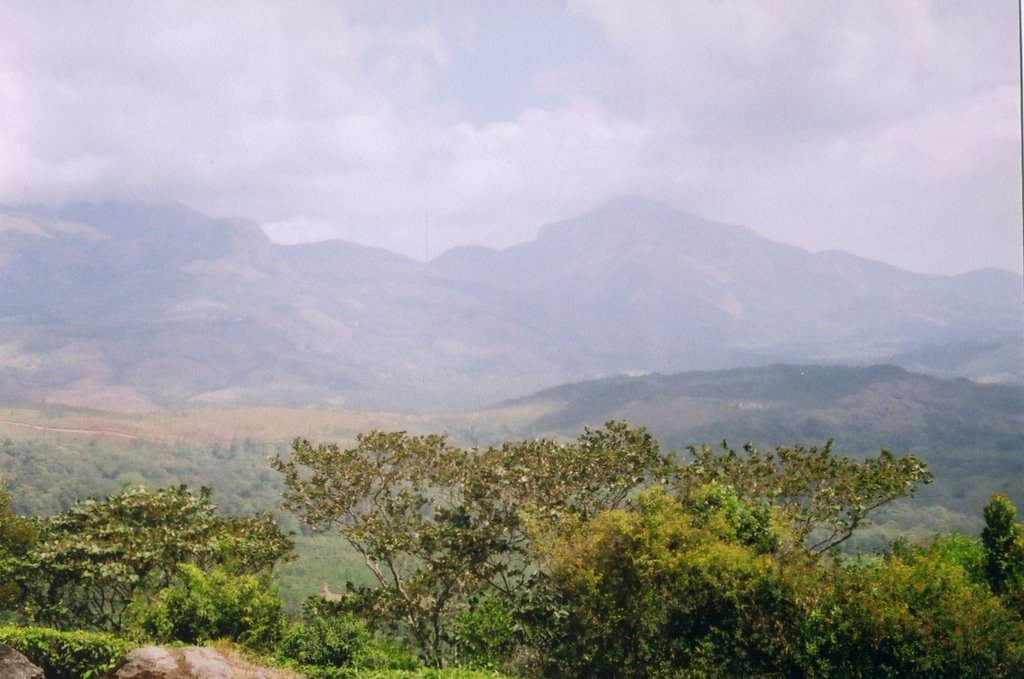
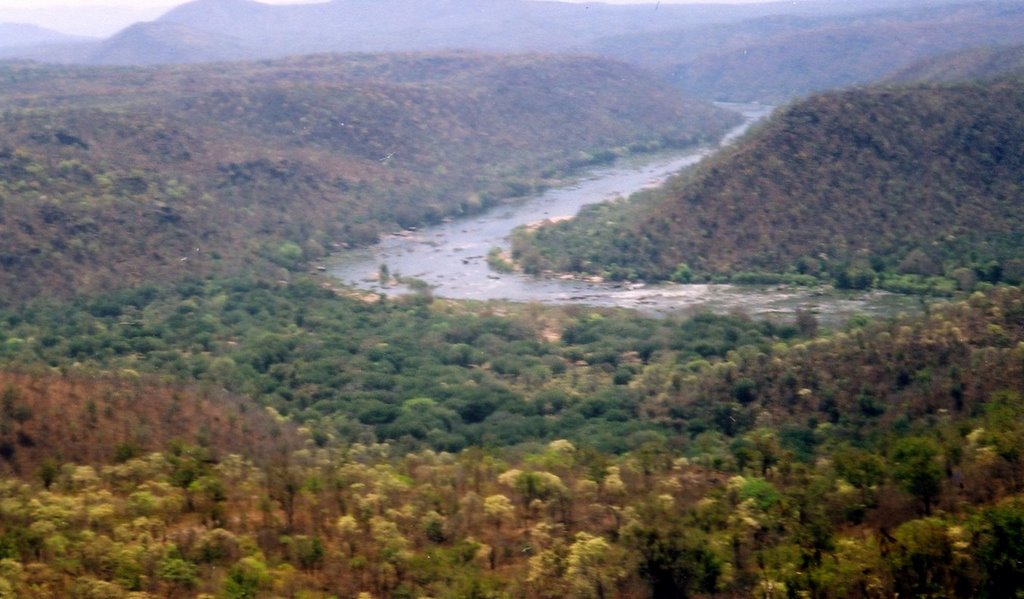
We started our journey from Metallurgy dept. at IISc at around 5:30 a.m. Me and Jackie in one bike while Kiran was Kotts behind him. We went via Jayanagar and left the city via the Kanakpura road. The roads became better once we left the city! Bangalore to Kanakpura is 55 km by road and that was our first destination. We reached Kanakpura at 7: 00 a.m. and had our breakfast in a small restaurant. Kanakpura is quite big place. Our second destination was Sathnur, which is around 16 km. away from Kanakpura, and the satisfying fact was that road was really good in this stretch too. We reached there at around 8:15 a.m. Sathnur has three diversions at a circle, if you take the straight one you will reach Muthati, Left will take you to Bhimeswari and the right will take you to Cauvery fishing camp. We took the straight road. Muthati is 18 km away from Sathnur. The road was newly polished and you start experiencing bits of hills from here. It is onset of the summer and the traces of leaves on the foreground of clear blue sky appeared really beautiful. Our bikes gave a good service including one skid on the road side, except that our journey to Muthati was quite smooth. Muthati is a picnic spot like, Bhimeswari on the banks of cauvery, and like other picnic spot it was noisy, dirty with bottles and papers and chips packets. We avoided going to the river in Muthati. Instead we went to the forest office and fixed our trek route. The entry fees per head to the hills was Rs. 100/- and guide fee was Rs. 50/- per head. Mystery trails has all these details. Our guide was Mutthuraj, a young chap with cool nature. He trekked all along with us in bare feet. We started our trek at 9:30 a.m. The trails began with a thorny uphill climb. Our first trek destination was Devanamundi hills. The day was quite hot, though not unbearable. It wasn’t a very steep climbing up too. This place has quite a few specimens of wild animals we saw some signs of bear and Elephant while climbing up, but alas we couldn’t see them physically! We had to put few breaks before we reached the top of the hills. It is a typical ghats hill top: rocky and bare, no signs of shade. We took almost 2 hr to reach there. The Cauvary river valley was visible from the hill top. The river flowing by tearing apart the hills was a spectacular landscape to cherish. The complete valley was visible from there. If you have a strong eye you can identify the Chnichi water falls at extremely far away, the falls is like a white streak on the green background. I am sure sunset from that point will be a treat to watch. The peak was almost 4 km from Muthati. Our next destination was Bhimeswary, which is a place on the banks of Cauvary, hence we started descending. Almost complete trail was covered by leaf less trees! We stopped in the middle near a pond which appeared to be the main source of water for the animals; we saw a wild hare too. It was the first water body we had seen in the whole stretch. We traveled almost 3 km and there came a watch tower. We could see the basin and Bhimeswari from there. It was another 3 km before we reached the river. We found a bunch of spotted deer on the way. Mutthuraj took us to a place which was really beautiful, on the riverside. It was already 1:30 p.m. and we had to take our lunch. Kotts and Kiran prepared nice Cucumber, Pickle, Jam Sandwiches, with fruit juice, lunch became quite heavy, and so we decided to trek back to Muthati through the banks of Cauvery. I liked this stretch the most. We traveled almost 2.5 km through this trail. Both sides of the river had hills or forest and the landscape was very nice. We reached the picnic spots soon and our fun also disappeared, it was again a noisy, boozing people who were spoiling the environment. The last 3-4 km. we had to walk on asphalt road which was quite painstaking and took all our energy out by the time we reached Muthati forest office. We bade good bye to Mutthuraj and started our journey back to Bangalore. It was almost 3:30 p.m. Thanks to Kiran and Jackie we had a trouble free journey back to Bangalore. It was a nice one day trek, and a desirable break from droning campus life.


Trek route: Muthati –Devanamundi-Bhimeswary-Muthati
Distance: 15 km, approximate time: 6hr.
From Bangalore –Kanakpura (55 km)-Sathnur (16 km)-Muthati(18 km)
Approximate expenditure: per head Rs.500-600/-
Orgnized by: Kanakpura forest office ( Ph No.080-7522537)


Saturday, March 04, 2006

The small and the large colony


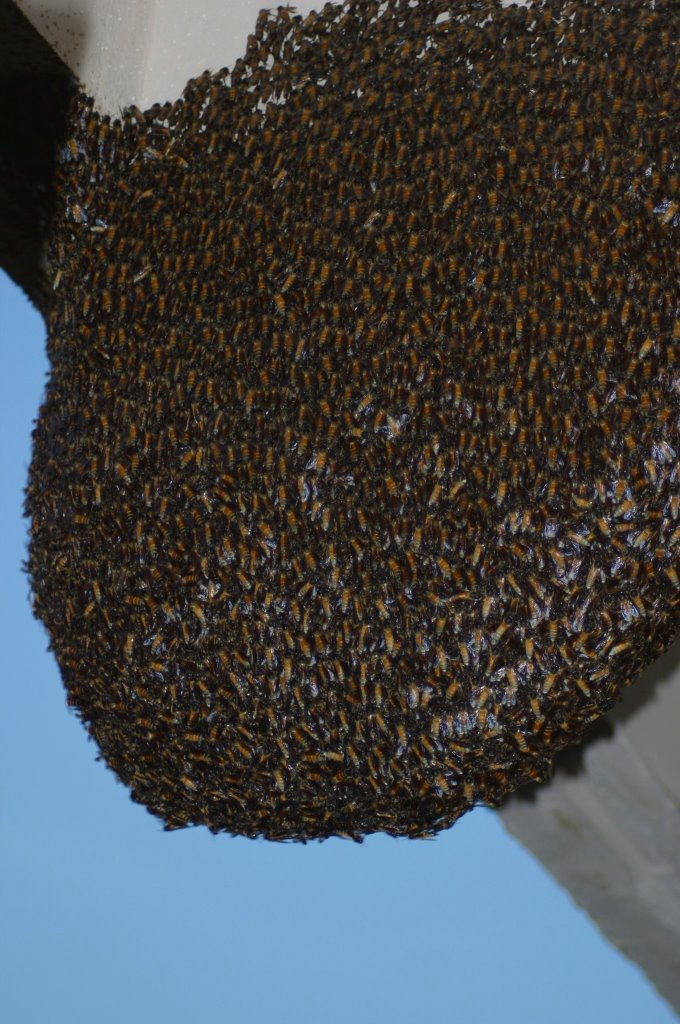
Sometimes back i wrote about them. I wrote about the tiny one and told the story about a big one. I did not have evidences for the big ones that is seen in my balcony. I was expecting them to come back and they certainly did! couple of days back the bees came back to my balcony for the third consecutive year. Like the migratory birds these bees somehow find my balcony! I wish there was a chance for me to build a tourist spot, i could have earned some money. It is really interesting how they come back to the same place and during same time of the year. Although the traces of their hives are wiped out each time, they build it at the same place. Mr. Ponnana from echological studies comes to remove them, he is an amazing guy, fearlessly he removes them. He has developed a technique which is an unique one, it kills less than 5% of the bees while breaking the hives. He showed me how the bees make their next destination. Once the house is under attack the few of the bees, always on their toes, run to find the next place , others find a temporary place to stay which may be a nearby tree or something that sort, once the search bees find the place the all fly to the new place. There are people who does serius resarch on this and can put much more interesting vews than this. For me, they (the bees!) are little bit of nuisance but no complains, i will peacefully share my balcony with millions of bees for next few days.

Monday, February 27, 2006

"Rail India"

Last couple of weeks I had roamed around a large part of India. I enjoyed Guru’s marriage in Trichy, presented a poster at MRSI-AGM in Lucknow. It was nice to go around few places within such short span of time. I was tempted to write about many things but thought about writing the strong impression I was carrying in mind for quite some time: Indian railways. Ram Guha in one of his famous talk series at CCS in IISc talked about how India as a country is in surviving, her binding and disintegrating forces working inside. One such binding force he mentioned is Indian Rail. The 150 yrs. old transport system has tremendous impact on the Indian society as a whole. One of the longest rail networks in the world is having maximum no. of stations too on her way. I would rather discuss about rail as a mode of conveyance than its commercial impacts. I frequently wonder, in practice what is similar in a life of a guy from Mangalore and one from Manipur. If he is not so cricket lover, which is not uncommon, he or she must identify themselves with railways systems. It is quite amazing how railways maintain similar system working in all corners of the country. The same bell rings with same frequency both in Guntur in AP and Tamna in West Bengal.
Indian rail began its journey in the year 1853 from Mumbai to Thane and within 10 yr. north, South east and West zone had rail tracks in different lengths. Today the total length of the railway track reaches upto 1.1 lakh km. Amazing isn’t it. We have broad gauge, meter gauge and narrow gauge tracks cumulatively making this length. Our rail runs from 20 meter under ground level to nearly 2500 m above mean sea level, which is the highest track after Quinghai- Tibet rail. Locomotives from electric to Disel and Steam can be seen running through track, though the steam locomotives are seen mostly out side the rail station now. Indian rail carries around 13 million people a day. Literally it is an unimaginable task; in order to ensure smooth functioning of this rail road system, Indian railways has become one of the largest recruiter in India. The employment is generated on national basis and people from all over the India travel from one corner to another.
Railway cities all over India have a very different culture as well as people. They are cosmopolitan in nature and the extent of cultural mix is quite significant. Whichever language you speak or whatever you eat, railway station is the safest place in the city (not always in terms of security). My trip from Chennai to Lucknow was quite an experience. Here I met one young couple who went for Honeymoon in Kanyakumar! That too from Lucknow, I asked him why Kanyakumari?, he said “..Because there is a direct train which takes us from Lucknow to Kanyakumari” Now here is a guy who probably would not have seen the tip of our country if there wasn’t this train. Like westerners we also develop some wrong notion about people of some places in our own country, just because we don’t know them haven’t seen them and didn’t know their culture, railways brought these cultures together more often than anybody. I came from Lucknow to Bhopal and from Bhopal I took Smapark kranti express to reach Bangalore. Here my fellow travelers were businessmen from Bangalore. One guy was from AP and another from Mangalore, they have business running from Delhi and both were mentioning how business prospects were different in north India compared to south India and they were pretty happy because of the prospects that were unfolded because of improvement in railway communication.
I was tempted to write more about it and one may find the write up pretty uninteresting since it doesn’t contain information. Well that because I found this group called Indian Railways Fan Club Association (IRFCA) who has already done a splendid job and their home page is really very informative, you can go and look at it, it is much interesting than this blog.
Cricket is almost a religion in India which brings all Indians on same platform, and we call our Indian cricket team as “team India”, probably for similar reason we can call Indian railways as “rail India”.

Few links

IRFCA

Indian Railways

Sunday, February 26, 2006

light of life

This photo, was hiding in some corner in my PC. When i took it, didn't have much impact but now i could see the life inside the light :-)

Friday, February 03, 2006

Pass it through nanotube, it'll be quick

When I started working on ceramic membrane I was fascinated by the science. Especially working with the unsupported alumina membrane where you control the pore size at the nanometer level. Its quite tricky playing with these membranes. The problem is associated with filtering. It can filter out very small molecules easily but as the channels becomes smaller the wall friction affects the flow (Hagen-Poisullie equation), thus quite high pressure is required to pass the fluid through filter. Duration of the filtering process due to low fluid velocity also becomes extremely long; certainly from application point of view this is disadvantageous. There is a brighter side of the story! Recently my undergrad seniour, Mainak has published a paper in Nature couple of months back on carbon nanotube membranes, this paper addressed very similar problems. This group from University of Kentucky has made multi walled carbon nanotubes with graphite as the inner core; the average channel diameter is around 7 nm. When water is filtered through these membranes, the fluid velocity was observed to be few orders of magnitude higher compared to the theoretical prediction. The experiment was carried out on few other fluids and the results were very similar, they also observed that the flow rate does not decrease with velocity of the fluid, that’s really an interesting observation. The reason cited for this enhanced flow is the hydrophobic nature of graphite which makes the wall almost friction less to flow. There is also a possibility of forming ordered hydrogen bonds inside the tube. This behaviour is analogous to the biological cells where water passes through the protein wall at considerable pace. Following this claim carbon nanotube will have a huge application coming in, mostly as sensors and filters against corrosive gases. The important part of the question which I felt quite interesting is: if the conventional concept fluid flow in a tube breaks in case of MWCNT, will it hold for other systems? Does nano has any effect here? I f you remember I wrote something about nanomechanics by John Pethica, where he mentioned an increase in viscosity of water molecule when put between very thinly spaced walls. Although these distances are smaller compared to nanochannels, the flow rate must get affected when the pore size is reduced more. That technology is yet to come; we will probably witness subnano effects influencing flow.

Thursday, January 19, 2006

Its not a "Bat", its Materials Engineering

They say cricket is ruled by batsmen. Unfortunately people get more entertainment for watching boundaries and overboundaries not by waiting for a wicket to fall. All these fun comes from couple of pieces rather few pieces of wood, called bat. International Cicket Council has a poor definition of this piece. A bat looks like this
can not be longer than 96.5 cm including the handle and maximum width shouldn’t exceed 10.8 cm. must be made of wood. There is no restrictions on the weight of the bat (typically 3 lb), the shape: well its understood, there is no definition by ICC. The blade of the bat can be covered with some material for protection and repair, should not strengthen the bat and the thickness of this cover should not exceed 1.56 mm. Recently a committee headed by Sunil Gavaskar, recommended some more criteria, the important one for this case is that you can not infiltrate anything in the blade moreover it should be made of one solid piece of wood.
Where is the scope for improvement? Material scientists and engineers step in here, before addressing this issue let us know where we need improvement. Of course ball should travel faster than what they do now. When a ball hits the bat at a very high speed, there are lots of vibrations and minimizing this has been challenge for sometimes. Striking the ball hard is easy when its hits at the “sweet spot”. This region is almost 12 cm above the bottom of the bat, the thickest part, we define this place as the place where minimum vibration is felt and the ball travels much faster. The sound we say heavenly when it hit this sweet spot. So extending the sweet spot region is also an important issue.
How to go about it? There are few research institute and Universities in Australia and in England are really doing quite a bit of research in these field. The departments associated with this are Material Science and Design, so its science and engineering combination. Lets see a bat, it has go 2 parts, one is solid part the one piece wood one and the other is the handle. The handle is a composite material its made up of canes put together with rubber and adhesive in between. This actually dampens the vibration which comes after the ball hits the bat. In RMIT university in Australia researchers are trying to make the handle with a composite material containing carbon fiber and polymer, this dampens the vibration more compared to conventional handle. This is the bat which probably Rickey Ponting wanted to use last year, under ICC supervision. In case of base ball bat the vibration control system is a piezoelectric device, which generates voltage to nullify the effect of vibration, it’s a software controlled process and these software were developed after a rigorous study on vibration, soon in cricket too we will see such modification setting in. Due to the rules we can not progress much with the blade part from the material science point of view, this is a pure problem for designers, design aspect only can extend the sweet spot. Tennis and Golf has progressed a lot in these regards. They are using the best possible materials for such application, reinforced graphite of bulk metallic glass are few should be named. Lets hope ICC will overcome its conservative resistance and make cricket more exciting.

Some links:

ICC home page

Bat size specification

Sunday, January 15, 2006

This one is really tiny


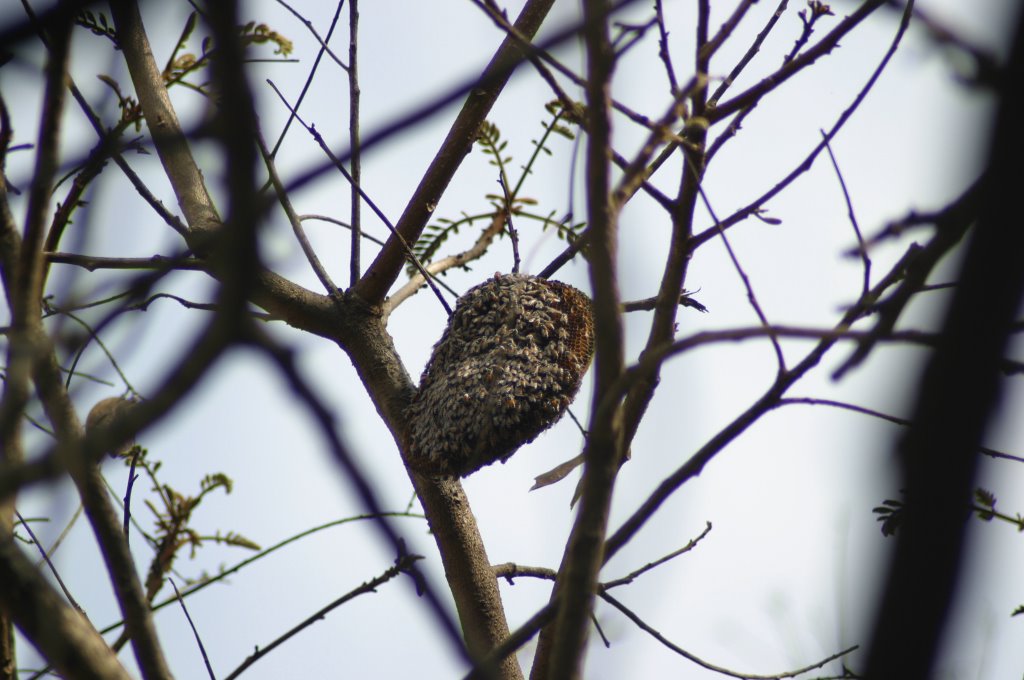
Phani noticed this hive yesterday; intially we did not know whether that is a bee hive or not, we thought it may be a flower but later i could see a bee flying. now it is almost clear that it is a bee hive. In our campus we are habituated in seeing the big hives with a diameter sometimes more than 2 feet. and the bee sizes are of few cm. For example the bee hives that is forming in my balcony for last two years in Feb, will be huge enough to scare any giant! first time i didnot open my balcony for 15 days, but when mr. ponnana came from CES to remove them, i got the courage and next year i did not feel troubled at all, it was my neighbours turn to get scared :), but this one is really tiny. Life cycle of bees has been roughed throughly in the literature, even text books in school contain detail about them. There are faculties in the Institute who are working on them, i hope to get some info about these bees and write and update.

Sunday, January 08, 2006

"Stardust" is coming back

Just couple of years back the image came in front page of thousands of magazines and news papers around the world. An aircraft colliding with a comet! Analogies were drawn with the movies like “deep impact” and “Armageddon” and details of the impact was getting significant attention of media when compared to politics and sports. The process was really accurate; the way it has been executed was amazing.
The reason I am discussing all these is: on Jan. 15, 2006. Stardust is coming back to earth after seven years of its launch and two years after it had hit the comet, gathered information and dust particles. This was one of NASA’s first endeavour towards the research on origin of life. The 25 kg spacecraft has already shifted its penultimate step towards journey to the earth and NASA says it was perfect. This comet is suppose to carry dust particles which is as old as life on earth and may contain some real evidence for it, but that is future, now the scientist are holding their nerves so that every thing goes smooth. There are reasons for concern, stardust is going to be the fastest return aircraft from space and it will hit the earth with a speed similar to a bullet. Although scientist have predicted that it will be visible from some places in USA in naked eye, but real challenge is tracking the spacecraft, and its place for impact. Wish everything goes well
My interest is in the materials part. Normally these spacecrafts have a shielding of carbon based refractory material, which can withstand temperature more than 5000 K, but here it will be tested. Due to very high friction the material will evaporate and the chemistry of the surface will change. It will be also interesting to see how it reacts to the impact. Heat shielding will really be a very important material for research. Stardust is coming back as an experimental result, which can not be carried out anywhere near earth.
Best of luck guys!


“Startdsust”

Saturday, January 07, 2006

A place named Purulya

I grew up in Purulia. One of the most peaceful places I have ever seen. Irony is that whenever I mentioned to someone that I hail from Purulia, they immediately recognize the place, “oh! Where the arms dropping took place?” I am sure soon people will identify the place again, for wrong reaons: “Oh! Where there is lot of unrest because of Naxalites?” No. This is not Purulia, and the people who did or doing all these are also not from Purulia. I was born in a place where, nobody was aware of peace because they had never seen violence, but it was quite an isolated district in Bengal more because its late inclusion in the state. Although the district was lagging behind in terms of economy, education, food crop production, yet culturally is much ahead of the other districts in the state, and fortunately, partition couldn’t touch it. “Chhau” the dance is considered as one of the cultural symbol of not only of west Bengal but also in some cases India, but then like “kathakali” we did not have money to protect it, and it is difficult to practice culture when you earn a meager meal once a day! then there was “Tusu and Bhadu”. “Sankrnati” is celebrated as the harvesting festival in major part of India, Purulia is also not an exception, but there is “Tusu and Bhadu”. Crop harvest is very small in the district and that’s being one of the major causes for economic fall in this part. “Bhadu” is a festival of woman and they make nice structures like temples with colourfull papers. You will see a procession of woman singing songs, they are not written anywhere! People memorize it. I heard recently that there is an effort to have them in written form. So this is Purulia. In our childhood we knew more about “Pataliputra” than Calcutta.
Purulia is extremely politically impassive and religiously indifferent district. It has more than one third of villages staying below poverty line. Industries were opened and shutdown came sooner than expected, thanks to the unions which were very active in these cases. A perfect situation for exploited by the Maoist groups. The recent killings in Bundwan can not really justify any cause. Its good if someone comes ahead and fight for the people’s right, but violence can take it anywhere. I remember a place called Duarsini, near Bundwan we went for picnic when I was in school, now that place even armed men wont venture to go. Its valid for Kuilapal another beautiful landscape was developing as a tourist spot no longer a destination for tourists. A little more attention would have changed lot of things, still I believe people don’t like violence but at the same time their affinity towards government probably is not mention worthy.
Changes that took place certainly were late; development is taking place from the middle of nineties. Town wise Purulia has advanced quite a bit, you can get mobile phones servies from atleast four to five service providers. The huge pump storage power project in collaboration with Japan in Ayodhya hills has really changed the roads, economy of this region. Even 15 years back it was a nightmare to go to the hills in rainy season, it has improved now. Government although not new is trying to boost up the economy. Its almost 8 years since I last visited Purulia, wish when I go there next time it will be the same cool and hot "Purulya".

Friday, December 30, 2005

Candle lit vigil

Today the students in the campus have decided to have a candle lit vigil in front of the main building. It is a geture we carry out to pay homage to the souls who are no longer around us and for spreading the message of peace. It was a very peaceful gathering of 150 students. The director, prof. Balram was as usual very inspiring but appeared really weary, of course because of the unusual circumstances he faced. We condoled the sudden demise of Prof. Puri, and hoped for a faster recovery of those who are recovering in the hospital. After the vigil we had put the candles at the steps wher J. N. Tata is standing tall. The glowing light carried a promise to walk ahead and and remeber the Prof. Puri. At the end the gathering was asked to speak a few words but the silence was talking; We all despised this heinous act.